


JLB, I would like to leave you with more on the history of 1 Timothy 3:16 as @dak already pointed to, in his post. Keep it for future reference. I generated this years ago and improved upon it a bit. I really hope you can understand it, even after a few reads.No. Scripture isn't flawed. It's inspired by God. What's flawed is your understanding of it.
Jesus Christ is God manifested in the flesh.
And without controversy great is the mystery of godliness:
God was manifested in the flesh,
Justified in the Spirit,
Seen by angels,
Preached among the Gentiles,
Believed on in the world,
Received up in glory. 1 Timothy 3:16
Sorry that you don't understand plain and clear words of scripture.
Jesus Christ is LORD; YHWH
Thanks
-----------------------------------------------------
1 Timothy 3:16
This verse is set as a creed as a hymn in poetic language.The controversy centers around the use of the word ‘God’ or ‘who’ or ‘which, or ‘He.’ Now the message of the verse really does not alter by using any of the choices, although some will take the opportunity if the word is ‘God’ as the more acceptable word, as proof that Yeshua, the Son of God is also God the Son. And fail to realize the point of the verse is about Yahshua's’ life of godliness, shown in segments.
If God is used it surely does NOT mean God the Son is revealed in the flesh. It can mean that since God was in his Son, then his Father who is God was revealed through his Son, who was born human person. And if one of the other three choice of words was the best fit, then it would clearly reveal Yeshua the human being as part of the theme of godliness. And thus indicating his natural and yet unique method of creation.
Now from the start it must be said that the use of the word 'God' was a later insertion into the verse.
The majority of modern critical editions of the Greek New Testament, such as the Nestle-Aland and United Bible Societies' texts, favor the reading "He who was manifested in the flesh" or "Who was manifested in the flesh" based on the earliest extant manuscripts, including Codex Sinaiticus, Codex Alexandrinus, and others.
“God was manifested in flesh” is what we still have in the Textus Receptus but they who follow the Westcott & Hort / Nestle text do not have it.
In An Historical Account of Two Notable Corruptions of Scripture (posthumously published in 1754), Isaac Newton argues that a small change to early Greek versions of this verse effectively changed "which" (referring to godliness) was changed to "God". This change increases textual support for trinitarianism, a doctrine to which Newton did not subscribe. There is evidence that the original Greek read 'ος' but was modified by the addition of a strikethrough to become 'θς' (see the excerpt from the Codex Sinaiticus, above). 'θς' was then assumed to be a contraction of 'θεος.' The biblical scholar Metzger explains, "no uncial (in the first hand) earlier than the eighth or ninth century (Ψ) supports θεος; all ancient versions presuppose ὃς or ὃ; and no patristic writer prior to the last third of the fourth century testifies to the reading of θεος."[24] In other words, Bible manuscripts closest to the original said 'who' and not 'God' in verse 16.
[ Source for paragraph above : First Epistle to Timothy - Wikipedia ]
The difference between these two readings has nothing to do with anyone wanting to "weaken the relationship between Father and Son"; it is simply a statement of fact consistent with the textual philosophy of the particular version being used. More specifically:
- If we accept that earlier manuscripts are more likely to have the original text, then we essentially arrive at the UBS5/NA28 text. In 1 Tim 3:16 this gives "he/who" uniformly for all early MSS
- If we accept the much later Byzantine text, then we essentially arrive at the Robinson-Pierpoint text (quite different from the TR but similar to the majority text). In 1 Tim 3:16 this gives "God".
The Companion Bible adds the understanding that it’s probable that an earlier reading was the neuter pronoun ho (which), to agree with mustērion, the Greek word translated “mystery,” which is also neuter. This agrees with the Syriac Version and all the Latin Versions….[1]
1 Timothy 3:16 in Codex Alexandrinus
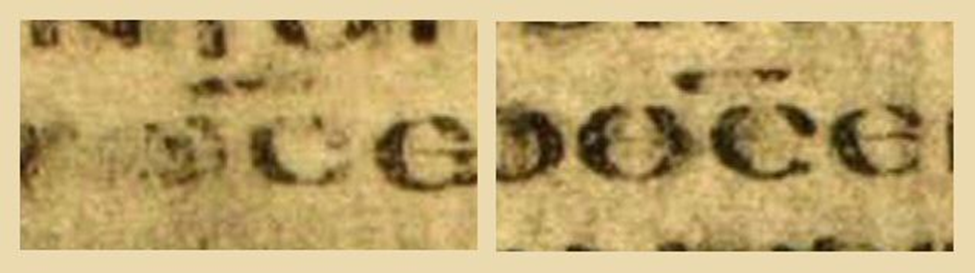
Reproduced below is the text of 1 Timothy 3:16–4:3 from Codex A, as presented in the photographic facsimile volume published by the British Museum in 1879. Of particular interest here is the reading in 3:16, where it may be seen that the manuscript reads ΘC "God was manifested in the flesh," employing the usual abbreviation ΘC for ΘEOC, with a stroke over the letters to indicate an abbreviation. However, textual critics believe that the ink in the center of the Θ and the stroke above were added by a corrector in modern times. Reasons for this belief are the color of the ink, and the fact that a "dot" has been placed in the Θ instead of a line. Tregelles writes, "The ink in which this has been done in A is sufficiently modern and black to declare its recent application" (An Account of the Printed Text of the Greek New Testament, London, 1854). Without these marks, the manuscript originally read ΟC "He who was manifested in the flesh." In the photograph below the ΘC in 3:16 is circled. Further down, in verse 4:3, there is another ΘC circled for comparison. Click on the circled areas for a larger view.[2]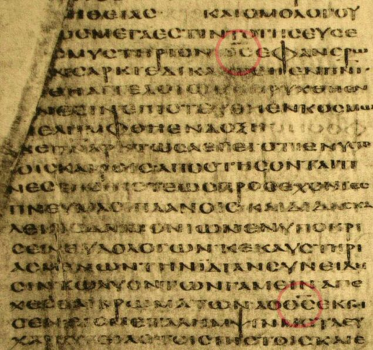
[1] (Way, 2021)
[2] (1 Timothy 3:16 in Codex Alexandrinus)
Last edited:


