The "sudden destruction" from which unbelievers "will not escape" on the day of the Lord will be caused by fire coming down on the earth.

  • Welcome to Christian Forums, a Christian Forum that recognizes that all Christians are a work in progress.

    You will need to register to be able to join in fellowship with Christians all over the world.

    We hope to see you as a part of our community soon and God Bless!

Spiritual Israelite

Well-Known Member
Apr 13, 2022
16,902
6,853
113
Midwest
Faith
Christian
Country
United States
Gender
Male
No the planet was not destroyed. Ge refers to the planet.

Kosmos is referring to the world of plants and all flesh that had the breath of life from God in it. It does not have the same meaning as the English word Cosmos.


No you have conflated them to make them adhere to what you are saying about the planet's destruction. There is a reason why scripture uses two different words.


The planet (ge) was not destroyed. All flesh was destroyed, with the exception of the redeemed.


Fire does not destroy the ground though. It will not cause the Ge to dissolve.


Thank you - you see how you have proved yourself wrong about the reason there are different words used by Peter for earth (Ge) and kosmos (the global destruction of all flesh).


Agreed.
I didn't prove myself wrong. You are just not wanting to acknowledge that the earth and the world can mean the same thing. A reference to the earth being destroyed does not have to refer to the entire earth including its core, etc. It can refer to the surface of the earth and the things (plants, animals, people, etc.) on the earth. The following refers to both the earth and the world being destroyed by the flood waters in the same context.

Genesis 9:11 Thus I establish My covenant with you: Never again shall all flesh be cut off by the waters of the flood; never again shall there be a flood to destroy the earth.”

2 Peter 3:5 For this they willfully forget: that by the word of God the heavens were of old, and the earth standing out of water and in the water, 6 by which the world that then existed perished, being flooded with water.

These verses talk about both the earth and the world being destroyed by the flood, so that shows the words can be used as synonyms.
 

Spiritual Israelite

Well-Known Member
Apr 13, 2022
16,902
6,853
113
Midwest
Faith
Christian
Country
United States
Gender
Male
The word heavens (ouranos) when appearing in plural form in English = the universe.

It's not the same as the meaning of the Greek word kosmos - which in English refers to the universe, but not in the Greek.

The word in Greek for the planet earth is ge.

kosmos is the world and everything in it.

No, neither the heavens (universe) nor the planet earth (ge) will be "dissolved" - but the rudiments and principles (stoicheon) of this current world order - the kosmos in Greek - and the works (ergon) of men in it will be destroyed by fire - and the earth (ge) will be loosed (luo) from its bondage to decay - which is what the word luo means - which has been translated into English as "dissolved".
Do you see the fire as being literal, physical fire or do you see it only as being figurative? It's clear to me that Peter compared a future literal, physical, global destruction event to a past one (the flood in Noah's day) in 2 Peter 3:6-7.
 

Spiritual Israelite

Well-Known Member
Apr 13, 2022
16,902
6,853
113
Midwest
Faith
Christian
Country
United States
Gender
Male
Because it does not agree with the notion that the heavens (ouranos) and the earth (ge) will be dissolved.

The word "dissolved" is from the Greek luo, which means to be loosed from being bound by something - which in the context of 2 Peter 3:5-12 is being loosed from the bondage of decay.

There's nothing in there to say that it's the planet earth (ge) and the heavens (universe, ouranos) that will pass away

- it's the rudiments and principles of this present world (kosmos) and everything in this present world (kosmos) that will pass away.
The planet earth and the heavens will pass away in terms of how they are now and will be regenerated/renewed in the form of the new heavens and new earth where only righteousness will dwell.
 
  • Like
Reactions: Zao is life

Zao is life

Well-Known Member
Oct 3, 2020
5,244
1,863
113
Africa
Faith
Christian
Country
South Africa
Gender
Male
The planet earth and the heavens will pass away in terms of how they are now and will be regenerated/renewed in the form of the new heavens and new earth where only righteousness will dwell.

Of course.

Noah's day (after the ark rested on Mt Ararat): Same ge (earth): Same rocks, same water, same chemical elements, same air, same everything

- but with the exception of Noah & fam, the kosmos (world) of old had been destroyed

- and death and decay was still there.

After the return of Christ: No more death and decay:

Romans 8
19 For the creation eagerly waits for the revelation of the sons of God.
20 For the creation was subjected to futility - not willingly but because of God who subjected it - in hope
21 that the creation itself will also be set free from the bondage of decay into the glorious freedom of God's children.
22 For we know that the whole creation groans and suffers together until now.
23 Not only this, but we ourselves also, who have the firstfruits of the Spirit, groan inwardly as we eagerly await our adoption, the redemption of our bodies.
24 For in hope we were saved. Now hope that is seen is not hope, because who hopes for what he sees?
25 But if we hope for what we do not see, we eagerly wait for it with endurance.

Paul links the regeneration of the entire creation to the resurrection of the sons of God in the above verses.

Do you see the fire as being literal, physical fire or do you see it only as being figurative? It's clear to me that Peter compared a future literal, physical, global destruction event to a past one (the flood in Noah's day) in 2 Peter 3:6-7.

It needs to be squared up with what the Revelation 19 tells us about the beast's armies being destroyed by the sword proceeding out of the mouth of Christ, and with what 2 Thessalonians 2 tells us about the man of sin being consumed with the spirit of Christ's mouth and being destroyed with the brightness of his coming; and with what Revelation 16 tells us about the hail in the seventh bowl of wrath (likewise with the seventh trumpet).

It also needs to be squared up with the symbols of lightnings, thunderings, voices and an earthquake seen in the 7th trumpet and 7th bowl of wrath and with the lightnings, thunderings, and voices seen in the 7th seal.

All of those could be referred to figuratively as "fire".

2 Thessalonians 1
8 In flaming fire taking vengeance on them that know not God, and that obey not the gospel of our Lord Jesus Christ:
9 Who shall be punished with everlasting destruction from the presence of the Lord, and from the glory of his power;
10 When he shall come to be glorified in his saints, and to be admired in all them that believe (because our testimony among you was believed) in that day.

Revelation 19
20 And the beast was taken, and with him the false prophet that wrought miracles before him, with which he deceived them that had received the mark of the beast, and them that worshipped his image. These both were cast alive into a lake of fire burning with brimstone.
21 And the remnant were slain with the sword of him that sat upon the horse, which sword proceeded out of his mouth: and all the fowls were filled with their flesh.

Is the lake of fire literal and referring to the literal destruction of the world (kosmos) by literal fire?

I don't know. There seems to be a distinction between the destiny of the beast and false prophets and the destiny of the rest of the beast's armies.

So I have not made up my mind.

Meaning I don't know.
 
Last edited:

Spiritual Israelite

Well-Known Member
Apr 13, 2022
16,902
6,853
113
Midwest
Faith
Christian
Country
United States
Gender
Male
It needs to be squared up with what the Revelation 19 tells us about the beast's armies being destroyed by the sword proceeding out of the mouth of Christ,
That is clearly symbolic.

and with what 2 Thessalonians 2 tells us about the man of sin being consumed with the spirit of Christ's mouth
Again, clearly symbolic.

and being destroyed with the brightness of his coming;
Symbolic.

and with what Revelation 16 tells us about the hail in the seventh bowl of wrath (likewise with the seventh trumpet).
Symbolic.

It also needs to be squared up with the symbols of lightnings, thunderings, voices and an earthquake seen in the 7th trumpet and 7th bowl of wrath and with the lightnings, thunderings, and voices seen in the 7th seal.

All of those could be referred to figuratively as "fire".
All of those are contained within the most highly symbolic book in the Bible except for 2nd Thessalonians. The brightness of His coming is kind of a vague reference, so it's hard to say what that means exactly. In contrast, there is nothing in 2nd Peter 3 to suggest that Peter is not being literal. Especially when you consider that he compares that future fiery event to a literal physical event of the past. It's clear to me that he was comparing like events.

2 Thessalonians 1
8 In flaming fire taking vengeance on them that know not God, and that obey not the gospel of our Lord Jesus Christ:
9 Who shall be punished with everlasting destruction from the presence of the Lord, and from the glory of his power;
10 When he shall come to be glorified in his saints, and to be admired in all them that believe (because our testimony among you was believed) in that day.
That lines up with 2nd Peter 3:10-12 and there's nothing in that passage to suggest that Paul is being anything but literal in that passage.

Revelation 19
20 And the beast was taken, and with him the false prophet that wrought miracles before him, with which he deceived them that had received the mark of the beast, and them that worshipped his image. These both were cast alive into a lake of fire burning with brimstone.
21 And the remnant were slain with the sword of him that sat upon the horse, which sword proceeded out of his mouth: and all the fowls were filled with their flesh.

Is the lake of fire literal and referring to the literal destruction of the world (kosmos) by literal fire?
The lake of fire is related to what happens at the end of the judgment after Christ has judged everyone and not to what happens immediately upon Christ's return.

I don't know. There seems to be a distinction between the destiny of the beast and false prophets and the destiny of the rest of the beast's armies.

So I have not made up my mind.

Meaning I don't know.
That's fine, but the lake of fire is different than the fire that comes down from heaven when Jesus returns. In my view, the fire of 2 Peter 3:10-12 and Revelation 20:9 is not the lake of fire.
 

Zao is life

Well-Known Member
Oct 3, 2020
5,244
1,863
113
Africa
Faith
Christian
Country
South Africa
Gender
Male
I didn't prove myself wrong. You are just not wanting to acknowledge that the earth and the world can mean the same thing.

Genesis 9
11 And I will establish my covenant with you; neither shall all flesh be cut off any more by the waters of a flood; neither shall there any more be a flood to destroy the earth [erets].

Noah's day (after the ark rested on Mt Ararat): Same ge (earth): Same rocks, same water, same chemical elements, same air, same everything

- but with the exception of Noah & fam, the [H 8398 tebel; G2889 kosmos] (world) of old had been destroyed.

A reference to the earth being destroyed does not have to refer to the entire earth including its core, etc. It can refer to the surface of the earth and the things (plants, animals, people, etc.) on the earth.

The earth (ge) was not destroyed in Noah's day. The kosmos (world) was.

The following refers to both the earth and the world being destroyed by the flood waters in the same context.

Genesis 9:11 Thus I establish My covenant with you: Never again shall all flesh be cut off by the waters of the flood; never again shall there be a flood to destroy the earth.”

2 Peter 3:5 For this they willfully forget: that by the word of God the heavens were of old, and the earth standing out of water and in the water, 6 by which the world that then existed perished, being flooded with water.

Genesis 9:11 is translated from Hebrew. 2 Peter is translated from Greek. This is what kosmos ALWAYS means in the Greek:

Matthew 4:8
Again, the devil taketh him up into an exceeding high mountain, and sheweth him all the kingdoms of the world [G2889 kosmos], and the glory of them;

Matthew 5:14
Ye are the light of the world [G2889 kosmos]. A city that is set on an hill cannot be hid.

Matthew 13:38
The field is the world [G2889 kosmos]; the good seed are the children of the kingdom; but the tares are the children of the wicked one;

Matthew 16:26
For what is a man profited, if he shall gain the whole world [G2889 kosmos], and lose his own soul? or what shall a man give in exchange for his soul?

John 14:19
Yet a little while, and the world [G2889 kosmos] seeth me no more; but ye see me: because I live, ye shall live also.

It's a very long list of verses using the word kosmos in the New Testament - and it's always talking about the world [kosmos] but not about the planet earth [ge].

2 Peter 3
5 For this they willingly are ignorant of, that by the word of God the heavens [G3772 ouranos] were of old, and the earth [G1093 ge] standing out of the water and in the water:
6 Whereby the world [G2889 kosmos] that then was, being overflowed with water, perished:
7 But the heavens [G3772 ouranos] and the earth [G1093 ge], which are now, by the same word are kept in store, reserved unto fire against the day of judgment and perdition of ungodly men.

The flood destroyed the world [kosmos] of ungodly men in Noah's day. Fire will destroy the world [kosmos] of ungodly men when Christ returns.

In neither case is it the destruction of the planet earth [ge] being spoken about.


These verses talk about both the earth and the world being destroyed by the flood, so that shows the words can be used as synonyms.

No you are just want to deny the facts when the facts do not adhere to your assertions.
 
Last edited:

Spiritual Israelite

Well-Known Member
Apr 13, 2022
16,902
6,853
113
Midwest
Faith
Christian
Country
United States
Gender
Male
Genesis 9
11 And I will establish my covenant with you; neither shall all flesh be cut off any more by the waters of a flood; neither shall there any more be a flood to destroy the earth [erets].

Noah's day (after the ark rested on Mt Ararat): Same ge (earth): Same rocks, same water, same chemical elements, same air, same everything

- but with the exception of Noah & fam, the [H 8398 tebel; G2889 kosmos] (world) of old had been destroyed.


The earth (ge) was not destroyed in Noah's day. The kosmos (world) was.
These discussions are very pointless unless we define terms. How are you defining the word "destroyed"? Obviously, we're not talking about annihilation here. But, many things on the surface of the earth, including plants, trees, animals, humans, buildings, etc. were destroyed by the flood. So, the earth was destroyed in that sense. The world was destroyed in that sense. Those words are used as synonyms in terms of describing the destruction that the flood in Noah's day caused.

You say the earth was not destroyed in Noah's day despite Genesis 9 explicitly saying that the flood destroyed the earth. According to Genesis 9:11, the earth was destroyed by the flood in some sense, so you can't just deny that the earth was destroyed by the flood when scripture itself says that it was.

And, with that, I have nothing more to say on this topic. I think we agree, either way, that the wicked and wickedness will be removed from the earth when Jesus returns, resulting in the new earth where righteousness dwells. Correct?
 

Zao is life

Well-Known Member
Oct 3, 2020
5,244
1,863
113
Africa
Faith
Christian
Country
South Africa
Gender
Male
All of those are contained within the most highly symbolic book in the Bible except for 2nd Thessalonians.

2 Thessalonians 2 mentions the man of sin being consumed by the Spirit of Christ's mouth. Revelation 19 mentions armies being killed by the sword proceeding out of His mouth. There's not much difference. Either they are both symbolic, or not.

In contrast, there is nothing in 2nd Peter 3 to suggest that Peter is not being literal.

I don't have a problem with literal fire destroying the world, if literal fire is the case. What I don't agree with is the conflation of the world with the planet earth.

Genesis 9
11 And I will establish my covenant with you; neither shall all flesh be cut off any more by the waters of a flood; neither shall there any more be a flood to destroy the earth [erets].

It's translated from the Hebrew but we know the planet earth was not destroyed:

Noah's day (after the ark rested on Mt Ararat): Same erets / ge (earth):
Same rocks, same water, same chemical elements, same air, same everything

- but with the exception of Noah & fam, the [H 8398 tebel; G2889 kosmos] (world) of old had been destroyed.

The earth (erets / ge) was not destroyed in Noah's day. The kosmos (world) was.


2 Peter 3

5 For this they willingly are ignorant of, that by the word of God the heavens [G3772 ouranos] were of old, and the earth [G1093 ge] standing out of the water and in the water:

6 Whereby the world [G2889 kosmos] that then was, being overflowed with water, perished.

The world perished BY the waters of the earth that was standing out of the water and in the water.


The New Testament is translated from Greek, and there is a very long list of verses using the word kosmos in the New Testament - and it's always talking about the world [kosmos] - but not about the planet earth [ge].

I already gave you these examples, but I'll repeat them:

Matthew 4:8
Again, the devil taketh him up into an exceeding high mountain, and sheweth him all the kingdoms of the world [G2889 kosmos], and the glory of them;

Matthew 5:14
Ye are the light of the world [G2889 kosmos]. A city that is set on an hill cannot be hid.

Matthew 13:38
The field is the world [G2889 kosmos]; the good seed are the children of the kingdom; but the tares are the children of the wicked one;

Matthew 16:26
For what is a man profited, if he shall gain the whole world [G2889 kosmos], and lose his own soul? or what shall a man give in exchange for his soul?

John 14:19
Yet a little while, and the world [G2889 kosmos] seeth me no more; but ye see me: because I live, ye shall live also.

Especially when you consider that he compares that future fiery event to a literal physical event of the past. It's clear to me that he was comparing like events.

As above. You are still conflating the earth (planet) with the world.

That lines up with 2nd Peter 3:10-12 and there's nothing in that passage to suggest that Paul is being anything but literal in that passage.

As further above. He may be talking about literal fire destroying the world. He is not saying it will destroy the planet earth.

The lake of fire is related to what happens at the end of the judgment after Christ has judged everyone and not to what happens immediately upon Christ's return.

That's fine, but the lake of fire is different than the fire that comes down from heaven when Jesus returns. In my view, the fire of 2 Peter 3:10-12 and Revelation 20:9 is not the lake of fire.

That's also fine. Some may have an opinion on the difference between the lake of fire and the fire mentioned by Peter and some may believe they are both referring to the same thing.

The difference between being saved and baptized with the Holy Spirit and with fire and being destroyed by fire is all we need to understand.
 

Spiritual Israelite

Well-Known Member
Apr 13, 2022
16,902
6,853
113
Midwest
Faith
Christian
Country
United States
Gender
Male
As further above. He may be talking about literal fire destroying the world. He is not saying it will destroy the planet earth.
You keep saying that, but what does it even mean? Scripture says he destroyed the earth with the flood, but that obviously doesn't mean He annihilated planet earth. If you're simply saying that it doesn't say the planet earth will be destroyed in the sense of being annihilated, then I've made it clear that I agree with that multiple times.

That's also fine. Some may have an opinion on the difference between the lake of fire and the fire mentioned by Peter and some may believe they are both referring to the same thing.
They apparently aren't taking 1 Thessalonians 5:2-3 into consideration where Paul speaks of the same event and describes "sudden destruction" from which those in spiritual darkness "shall not escape" when the day of the Lord comes as a thief in the night. I doubt anyone would try to claim that Paul was talking about the lake of fire there.
 

Zao is life

Well-Known Member
Oct 3, 2020
5,244
1,863
113
Africa
Faith
Christian
Country
South Africa
Gender
Male
These discussions are very pointless unless we define terms. How are you defining the word "destroyed"? Obviously, we're not talking about annihilation here. But, many things on the surface of the earth, including plants, trees, animals, humans, buildings, etc. were destroyed by the flood. So, the earth was destroyed in that sense. The world was destroyed in that sense. Those words are used as synonyms in terms of describing the destruction that the flood in Noah's day caused.

You need to educate all those in these boards and the millions of other Christians who 100% believe that Peter is talking about the annihilation of planet earth, as well as the universe - and using 2 Peter 3:5-7 as their "proof text".

The words ge (earth) and kosmos (the world, the globe) are not synonymous in the New Testament (I showed it clearly again in my previous post) - and Peter is referring to both, but talking about the destruction of one, using Naoh's day and the flood as an example.

You say the earth was not destroyed in Noah's day despite Genesis 9 explicitly saying that the flood destroyed the earth.

I'm sure you do not believe that because Genesis 9:11 uses the word erets (earth) referring to the destruction of the "earth" in Noah's day, this means that after the ark rested on Mount Ararat, there were no more rocks, trees never grew again, no plants came up, there was no air to breathe, etc etc - the earth had become tohuw and bohuw.

It' obvious (to me anyway) that the word erets in Hebrew Genesis 9:11 is a synonym for the world that perished by the waters of the flood.

It's also 100% evident that the Greek does not use the words ge and kosmos interchanegeably or as synonyms in 2 Peter 3:5-7.

According to Genesis 9:11, the earth was destroyed by the flood in some sense, so you can't just deny that the earth was destroyed by the flood when scripture itself says that it was.

Your arguments are becoming difficult not to criticize with harsh words, IMO.

The world of old was destroyed by the flood but the earth itself was not, and in the Hebrew of Genesis 9:11 the word erets (earth) is synonymous with the word tebel (world).

In 1 Samuel 2:8 the words erets and tebel are used separately:

He raiseth up the poor out of the dust, and lifteth up the beggar from the dunghill, to set them among princes, and to make them inherit the throne of glory: for the pillars of the earth [H776 erets] are the LORD’s, and he hath set the world [H8398 tebel] upon them.

2 Peter 3:5-6
For this they willingly are ignorant of, that by the word of God the heavens [G3772 ouranos] were of old, and the earth [G1093 ge | H776 erets] standing out of the water and in the water: Whereby the world [G2889 kosmos | H8398 tebel] that then was, being overflowed with water, perished.

And, with that, I have nothing more to say on this topic. I think we agree, either way, that the wicked and wickedness will be removed from the earth when Jesus returns, resulting in the new earth where righteousness dwells. Correct?

Yes, we do agree about that. I'm glad you have nothing further to say on this topic because we're going around in circles again just repeating the same arguments.
 
Last edited:

Zao is life

Well-Known Member
Oct 3, 2020
5,244
1,863
113
Africa
Faith
Christian
Country
South Africa
Gender
Male
Scripture says he destroyed the earth with the flood

No it doesn't. The Hebrew Old Testament is using the word erets (earth) as a synonym for the word tebel (world) in Genesis 9:11. The Greek New Testament does not do that. See post #30 where I answered your false assertion about that.
 
Last edited:

Spiritual Israelite

Well-Known Member
Apr 13, 2022
16,902
6,853
113
Midwest
Faith
Christian
Country
United States
Gender
Male
You need to educate all those in these boards and the millions of other Christians who 100% believe that Peter is talking about the annihilation of planet earth, as well as the universe - and using 2 Peter 3:5-7 as their "proof text".
I have tried, but people tend to take scripture too literally at times. That text is literal, but not THAT literal, as if it's talking about the complete destruction and annihilation of the planet.

The words ge (earth) and kosmos (the world, the globe) are not synonymous in the New Testament (I showed it clearly again in my previous post) - and Peter is referring to both, but talking about the destruction of one, using Naoh's day and the flood as an example.
In this case, they are. We'll have to agree to disagree about that.

I'm sure you do not believe that because Genesis 9:11 uses the word erets (earth) referring to the destruction of the earth in Noah's day, this means that after the ark rested on Mount Ararat, there were no more rocks, trees never grew again, no plants came up, there was no air to breathe, etc etc - the earth had become tohuw and bohuw.
Of course not.

It' obvious (t me anyway) that the word erets in Hebrew Genesis 9:11 is a synonym for the world that perished by the waters of the flood.
Yes, exactly. So, the earth and the world can be synonyms in certain contexts, as I've been saying. Glad you agree.

It's also 100% evident that the Greek does not use the words ge and kosmos interchanegeably or as synonyms in 2 Peter 3:5-7.
It's 100% evident to me that it does, so....yeah. Is this worth arguing about back and forth endlessly? Not really.

Your arguments are becoming difficult not to criticize with harsh words, IMO.
I know that's always hard for you. Which is why we should just stop. It's not worth it. We do agree that the heavens and earth will be renewed and regenerated when Jesus comes rather than annihilated, right? I think we should just be content with agreeing about that and move on.

Yes, we do agree about that. I'm glad you have nothing further to say on this topic because we're going around in circles again just repeating the same arguments.
Exactly, so I don't plan to discuss it any further unless you happened to bring something new to the table.
 
  • Like
Reactions: Zao is life

Zao is life

Well-Known Member
Oct 3, 2020
5,244
1,863
113
Africa
Faith
Christian
Country
South Africa
Gender
Male
Had to come back to this because I need to make a correction regarding something I said earlier when I agreed with you regarding Genesis 9:11.

I'm sure you do not believe that just because Genesis 9:11 uses the word erets (earth) referring to the destruction of the "earth" in Noah's day, this means that after the ark rested on Mount Ararat, there were no more rocks, trees never grew again, no plants came up, there was no air to breathe, etc etc - the earth had become tohuw and bohuw.

These discussions are very pointless unless we define terms. How are you defining the word "destroyed"? Obviously, we're not talking about annihilation here. But, many things on the surface of the earth, including plants, trees, animals, humans, buildings, etc. were destroyed by the flood.

So, the earth was destroyed in that sense. The world was destroyed in that sense. Those words are used as synonyms in terms of describing the destruction that the flood in Noah's day caused.

It's good that you mentioned that we need to define terms - which you said in the context of acknowledging that it did not involve annihilation but everything upon the surface of the earth was destroyed in the flood

- because I need to make a correction regarding what I said below when I agreed with you about this, or at least to qualify what I said:

It' obvious (to me anyway) that the word erets in Hebrew Genesis 9:11 is a synonym for the world that perished by the waters of the flood.

I was wrong about Genesis 9:11 - and so are you. Here are the facts:

The Hebrew uses the word [erets] interchanegably throughout the Old Testament for the land and the earth (the planet earth):

Genesis 2:12
The gold of that land [erets] is pure; pearls and lapis lazuli are also there.

The Greek New Testament does the same using the word [ge]:

Matthew 2:6
And thou Bethlehem, in the land [ge] of Judah, art not the least among the princes of Judah: for out of thee shall come a Governor, that shall rule my people Israel.

The Hebrew uses the word [erets] for "land" (not the planet earth, but the land) throughout the flood narrative:

Genesis 6:12

12 And God looked upon the earth [erets] (the land), and, behold, it was corrupt; for all flesh had corrupted his way upon the earth [erets] (the land).
13 And God said unto Noah, The end of all flesh is come before me; for the earth [erets] (the land) is filled with violence through them; and, behold, I will destroy them with the earth [erets] (the land).

Just as Peter said in 2 Peter 3:5-6, God used the water of (the planet) earth to destroy the land of the ungodly world (the ungodly in the world) that were upon the land:

2 Peter 3:5-6

For this is hidden from them by their willing it, that the heavens [ouranos] were of old, and the earth [ge] out of the water, and through water, being held together by the word of God

- through which the world [kosmos] that then was, being flooded by water, perished.

The word Kosmos in the Greek = "the world" - it does not mean universe or Cosmos (the heavens), as it does in English

(- there are many verses in the New Testament using the word kosmos - each time it's unambiguously talking about the world - not "the universe" as the word "Cosmos" has come to mean in English) * Note 1 below the rest of this:

So I need to make a correction:


Genesis 9:11 is NOT using the Hebrew word [erets] both in reference to the earth (the planet earth) AND as a synonym for the Hebrew word [tebel]. (Tebel = the world, the equivalent of the Greek kosmos),

but Genesis 9:11 is referring to the land [erets] after God used the water in and surrounding the planet earth [erets] to destroy all flesh upon the land:

"And I will establish my covenant with you; neither shall all flesh be cut off any more by the waters of a flood; neither shall there any more be a flood to destroy the earth [erets] (the land)."

It takes us back to Genesis 6:12-13:

"And God looked upon the earth [erets] (the land), and, behold, it was corrupt; for all flesh had corrupted his way upon the earth [erets] (the land). And God said unto Noah, The end of all flesh is come before me; for the earth [erets] (the land) is filled with violence through them; and, behold, I will destroy them with the earth [erets] (the land)."

Genesis 9:11 is not referring to the earth (the planet), but to the land (the planet earth was not destroyed in the flood).

- It's referring to the land after God used the water of the planet earth to destroy all flesh upon the land.

Compare what God said with what God said:

Genesis 6:12

12 And God looked upon the earth [erets] (the land), and, behold, it was corrupt; for all flesh had corrupted his way upon the earth [erets] (the land).
13 And God said unto Noah, The end of all flesh is come before me; for the earth [erets] (the land) is filled with violence through them; and, behold, I will destroy them with the earth [erets] (the land).

Genesis 9:11
And I will establish my covenant with you; neither shall all flesh be cut off any more by the waters of a flood; neither shall there any more be a flood to destroy the earth [erets] (the land).

It's not referring to the earth (the planet), but to the land - just as Peter said in 2 Peter 3:5-6.

* Note 1:


Like the Greek word [kosmos], the Hebrew word [tebel] also always refers to the world (not the [erets], not the earth or the land)

- and out of the 26 times [tebel] is used in the Old Testament, some of the verses are using the word erets (earth) and the word tebel (world) in the same verse, making a distinction between the earth and the world - just as Peter does in 2 Peter 3:5-6, for example:

1 Samuel 2

8 He raiseth up the poor out of the dust, and lifteth up the beggar from the dunghill, to set them among princes, and to make them inherit the throne of glory: for the pillars of the earth [erets] are the LORD'S, and he hath set the world [tebel] upon them.

1 Chronicles 16:30

Tremble before him, all the earth [erets]! The world [tebel] is established, it cannot be moved.

There are other examples, but the above two are enough.

You cannot have it both ways, as you are trying to do.

Either the flood narrative in Genesis and 2 Peter 3:5-6 has nothing to do with the destruction of the (planet) earth but everything to do with the destruction of the land and all life - all flesh - in the land (the surface of the earth) - the (whole) world;

OR it has everything to do with the destruction of the (planet) earth itself.


The latter is FALSE - and you are trying to hold onto both with your statements regarding "not annihilated" and "the surface of the earth" as though both can be facts - which is just not possible:

These discussions are very pointless unless we define terms. How are you defining the word "destroyed"? Obviously, we're not talking about annihilation here. But, many things on the surface of the earth, including plants, trees, animals, humans, buildings, etc. were destroyed by the flood.

So, the earth was destroyed in that sense. The world was destroyed in that sense. Those words are used as synonyms in terms of describing the destruction that the flood in Noah's day caused.

It's not true what you say in the second paragraph - that's just you trying to hold onto two different realities for the sake of Amil doctrine regarding 2 Peter 3:5-12. What's true and factual is that erets (Hebrew) and ge (Greek) are used interchangeably in reference to the planet earth and the land, but there is a distinction made in both languages between the planet earth and the world.

Genesis 9:11 uses the word erets in reference to the land (not the planet earth), that was destroyed in the flood, and that can be a synonym for the world.

It does not preclude your belief that just as water covered the land, so fire will cover the land (what in English we commonly refer to as the earth).


So now I have corrected my error regarding my acknowledgement regarding your assertion regarding the word erets and what it's referring to in Genesis 9:11,

so I can continue to agree to disagree with what you are saying and with what you believe about what Peter meant.

 
Last edited:

Douggg

Well-Known Member
Nov 26, 2020
5,490
439
83
77
Memphis
Faith
Christian
Country
United States
Gender
Male
@Spiritual Israelite

Three points of understanding:

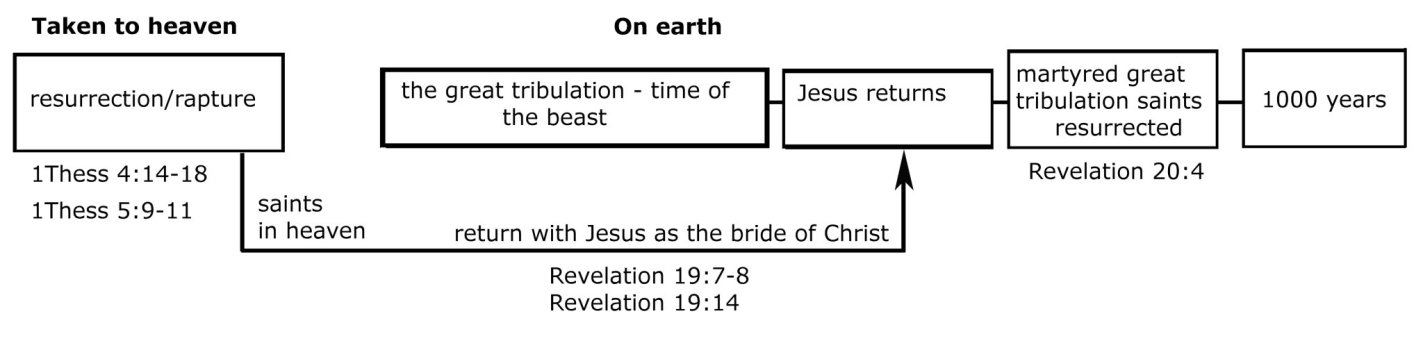
1. Since Jesus returns in Revelation 19 with His bride, both coming from heaven, the resurrection/rapture has to have taken place prior to His return. When ? When does the resurrection/rapture take place? We are told in point 2....

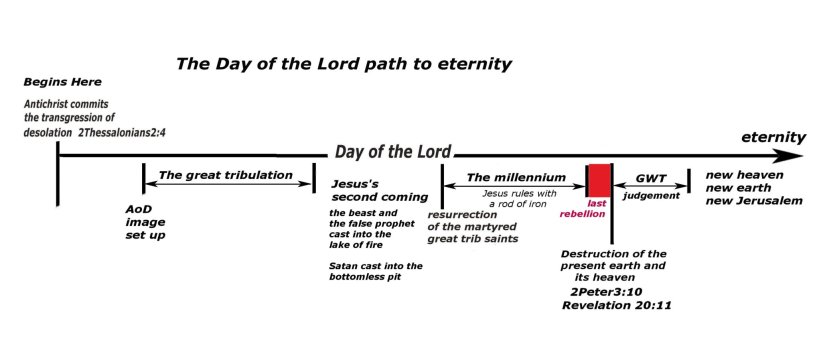
2. In 1Thessalonians5:9-11, the resurrection/rapture will take place before the day of the Lord begins when God's wrath will be poured out. When ? When does the day of the Lord begin ? We are told in point 3....

3. In 2Thessalonians2:1-4, the day of the Lord begins when the Antichrist in verse 4 goes into the temple, sits, claiming to be God. So the resurrection/rapture will take place before then. With the resurrected/raptured saints returning with Jesus as the bride of Christ, in Revelation 19.


first reusrecction.jpg
path to eternit2y.jpg
 
Last edited:

Zao is life

Well-Known Member
Oct 3, 2020
5,244
1,863
113
Africa
Faith
Christian
Country
South Africa
Gender
Male
@Spiritual Israelite

Three points of understanding:

1. Since Jesus returns in Revelation 19 with His bride, both coming from heaven, the resurrection/rapture has to have taken place prior to His return. When ? When does the resurrection/rapture take place? We are told in point 2....

2. In 1Thessalonians5:9-11, the resurrection/rapture will take place before the day of the Lord begins when God's wrath will be poured out. When ? When does the day of the Lord begin ? We are told in point 3....

3. In 2Thessalonians2:1-4, the day of the Lord begins when the Antichrist in verse 4 goes into the temple, sits, claiming to be God. So the resurrection/rapture will take place before then. With the resurrected/raptured saints returning with Jesus as the bride of Christ, in Revelation 19.


View attachment 78797
View attachment 78798

Your point #3 is 100% false, Douggg. Nowhere does 2 Thessalonians 2 tell us that the resurrection/rapture or the Day of the LORD will take place before 2 Thessalonians 2:4.

2 Thessalonians 2:4 is in fact what is going to begin 42 months of great tribulation of the saints at the hand of the beast.

There will be two witnesses prophesying during that period - who will be killed at the close of that period by the beast (Revelation 11).

Then they (the dead in Christ, including the martyred two witnesses) will rise first. Then the rest who are still alive will be raptured. It's only after this that the saints will return with Christ for the battle of Armageddon - which is the Day of the LORD.

Great tribulation is not talking about something that happened to Israel during 66-70 A.D. Neither is great tribulation talking about what will happen to the world when Christ returns with His saints for the battle of Armageddon (the Day of the LORD).

Great tribulation is talking about what happened to the saints under Nero even before 70 AD; and great tribulation in Matthew 24:21-22 is talking about the greatest period of great tribulation that the saints will ever have experienced or ever will experience again after the final great tribulation of the saints at the hand of the beast.

Your applying of the term tribulation and the term great tribulation to the world at the time of the Day of the LORD is your own pre-tribulation rapture wishful thinking. Scripture calls what the world will experience at the hand of Christ in the Day of the LORD W-R-A-T-H, NOT "The great tribulation".
 
Last edited:

Douggg

Well-Known Member
Nov 26, 2020
5,490
439
83
77
Memphis
Faith
Christian
Country
United States
Gender
Male
Your point #3 is 100% false, Douggg. Nowhere does 2 Thessalonians 2 tell us that the resurrection/rapture will take place before 2 Thessalonians 2:4/

The resurrection/rapture to take place before the day of the Lord begins.

The day of the Lord (called the day of Christ in 2Thessalonians2:2) will begin when the Antichrist goes into the temple, sits, claiming to be God, in 2Thessalonians2:4.

2Thessalonians2:
1 Now we beseech you, brethren, by the coming of our Lord Jesus Christ, and by our gathering together unto him, [the resurrection/rapture]

2 That ye be not soon shaken in mind, or be troubled, neither by spirit, nor by word, nor by letter as from us, as that the day of Christ [the day of the Lord] is at hand.

3 Let no man deceive you by any means: for that day shall not come, except there come a falling away first, and that man of sin be revealed, the son of perdition;

4 Who opposeth and exalteth himself above all that is called God, or that is worshipped; so that he as God sitteth in the temple of God, shewing himself that he is God.
 

Zao is life

Well-Known Member
Oct 3, 2020
5,244
1,863
113
Africa
Faith
Christian
Country
South Africa
Gender
Male
The day of the Lord (called the day of Christ in 2Thessalonians2:2) will begin when the Antichrist goes into the temple, sits, claiming to be God, in 2Thessalonians2:4.

False. The beast will reign for 42 months before the Day of the LORD comes.

2Thessalonians2:
1 Now we beseech you, brethren, by the coming of our Lord Jesus Christ, and by our gathering together unto him, [the resurrection/rapture]

2 That ye be not soon shaken in mind, or be troubled, neither by spirit, nor by word, nor by letter as from us, as that the day of Christ [the day of the Lord] is at hand.

3 Let no man deceive you by any means: for that day shall not come, except there come a falling away first, and that man of sin be revealed, the son of perdition;

4 Who opposeth and exalteth himself above all that is called God, or that is worshipped; so that he as God sitteth in the temple of God, shewing himself that he is God.

Where does Paul say in the above verses that the Day of the LORD will come the moment the man of sin seats himself up in the Temple of God? Nowhere in 2 Thessalonians 2. You have inserted that meaning into the text. Have you not read the rest of the New Testament?

Do you not know about the scripture that tells us that the beast will reign for 42 months and will make war against the saints?

Do you not know that in the New Testament the word tribulation is always talking about something the saints will experience, and that of the only three times it's described as great tribulation - two are in the Revelation and are unambiguously talking about tribulation as the experience of the saints - and that the first is in Matthew 24:21-22?

Do you not know that Jesus said that when the good news about the kingdom of Christ has been preached in all the world as a witness to all nations, that the saints will be hated by all nations for His name's sake, delivered up to tribulation and killed?

You evidently do not know the scriptures - not because you have not read the scriptures, but because you choose to ignore whatever you do not like to hear, and insert your own meanings into passages in scripture - such as your own meaning you have inserted in 2 Thessalonians 2 - a meaning that the passage does not convey.

As Jesus said many times, "He who has ears to hear, let him hear."

He knew that most who say they follow Him will not have ears to hear Him- which is the chief cause of the falling away that will occur when the man of sin appears out of the lawlessness Paul describes in 2 Thessalonians 2 (which is when the 42-month period of great tribulation that the saints will experience at the hand of the beast, begins) - 42 months before we are gathered together to be with Him.

PS Many who say they believe in Christ but do not have ears to hear Him will have ears to hear the man of sin of 2 Thessalonians 2, and follow him, taking part in the apostasy Paul mentioned.

You need to repent.
 
Last edited:
  • Like
Reactions: Davidpt

Spiritual Israelite

Well-Known Member
Apr 13, 2022
16,902
6,853
113
Midwest
Faith
Christian
Country
United States
Gender
Male
@Spiritual Israelite

Three points of understanding:

1. Since Jesus returns in Revelation 19 with His bride, both coming from heaven, the resurrection/rapture has to have taken place prior to His return.
False. He will return with the souls of the dead in Christ, which is what Paul refers to in 1 Thessalonians 4:14.


When ? When does the resurrection/rapture take place?
Immediately after the tribulation of those days, according to Jesus (Matthew 24:29-31, Mark 13:24-27).

We are told in point 2....

2. In 1Thessalonians5:9-11, the resurrection/rapture will take place before the day of the Lord begins when God's wrath will be poured out. When ? When does the day of the Lord begin ?
False. It will take place on the day of the Lord, which is the day that the Lord returns. Paul referred to one event in 1 Thessalonians 4:13-5:11. On that day that Jesus returns, right after Jesus descends from heaven with the souls of the dead in Christ and His angels, the dead in Christ will first be resurrected and then they, together with those who are alive and remain, will be gathered by the angels and caught up together to meet the Lord in the air. The Lord will then proceed to take vengeance on all unbelievers (2 Thess 1:7-10) who will experience "sudden destruction" from which "they shall not escape" (1 Thess 5:2-3).

We are told in point 3....

3. In 2Thessalonians2:1-4, the day of the Lord begins when the Antichrist in verse 4 goes into the temple, sits, claiming to be God. So the resurrection/rapture will take place before then. With the resurrected/raptured saints returning with Jesus as the bride of Christ, in Revelation 19.
You have the timing of everything all mixed up because you are not reading the scriptures carefully. Nowhere does 2 Thessalonians 2:1-4 indicate that "the day of the Lord begins when the Antichrist in verse 4 goes into the temple, sit, claiming to be God". What Paul indicated is that before the day of the Lord occurs, which he referred to as the day of Christ's second coming when we are gathered to Him, there will be a mass falling away from the faith (mass apostasy) and the man of sin will be revealed.
 
  • Like
Reactions: Davidpt

Spiritual Israelite

Well-Known Member
Apr 13, 2022
16,902
6,853
113
Midwest
Faith
Christian
Country
United States
Gender
Male
The resurrection/rapture to take place before the day of the Lord begins.

The day of the Lord (called the day of Christ in 2Thessalonians2:2) will begin when the Antichrist goes into the temple, sits, claiming to be God, in 2Thessalonians2:4.

2Thessalonians2:
1 Now we beseech you, brethren, by the coming of our Lord Jesus Christ, and by our gathering together unto him, [the resurrection/rapture]

2 That ye be not soon shaken in mind, or be troubled, neither by spirit, nor by word, nor by letter as from us, as that the day of Christ [the day of the Lord] is at hand.

3 Let no man deceive you by any means: for that day shall not come, except there come a falling away first, and that man of sin be revealed, the son of perdition;

4 Who opposeth and exalteth himself above all that is called God, or that is worshipped; so that he as God sitteth in the temple of God, shewing himself that he is God.
You are blatantly twisting the text to fit your doctrine and you have no shame about it. It's sickening to witness. In verse 1 Paul introduces the subject of Christ's second coming when we will be gathered unto Him. In verse 2 instead of repeating the long phrase "the coming of our Lord Jesus Christ...and our gathering together unto Him", Paul refers to that event as "the day of Christ" or "the day of the Lord". Then in verse 3 he refers to that event as "that day". Your attempt to turn vese 2 into some other event than what Paul first references in verse 1 is ridiculous. He did not change the subject from verse 1 to verse 2. Verses 1 to 3 all pertain to the day that Jesus will come and we will be gathered to Him.
 

Douggg

Well-Known Member
Nov 26, 2020
5,490
439
83
77
Memphis
Faith
Christian
Country
United States
Gender
Male
False. The beast will reign for 42 months before the Day of the LORD comes.
There is nothing in 2Thessalonians2:1-4 about 42 months of the beast's rule.

What is in 2Thessalonians2:1-4 is the day of Christ (the day of the Lord) does not begin until the man of sin is revealed by going into the temple, sitting, claiming to be God.