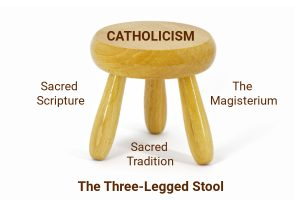
The Roman Catholic church certainly has evolved over the years.
Timeline / Evolution of Catholic Doctrines
325 – Only bishops and priests can conduct communion (First Council of Nicaea)
364 – Sunday Sabbath (Council of Laodicea / after Constantine’s decree in 321)
382 – The 73-book biblical canon approved at the Council of Rome, later reaffirmed by the regional Councils of Hippo (393) and Carthage (397)
398 – Prayers for the dead (Augustine alluded to it)
418 – Infant baptism regenerates (Council of Carthage)
553 – Mary’s ever-virgin state (Fifth Ecumenical Council in Constantinople)
600 – Confession to a priest (public confession transitioned to private in 600s)
993 – Canonization of first saint (St. Ulrich by Pope John XV)
1095 – Indulgences (Pope Urban II offered indulgences to certain persons who fought in or funded the Crusades)
1139 – Celibacy of priests (Second Lateran Council)
1208 – The Rosary (Dominic claimed to receive a revelation from Mary)
1215 – Clerical clothing required for church leaders (Fourth Lateran Council)
1215 – Transubstantiation (Fourth Lateran Council / approved the word “transubstantiation” for describing communion)
1274 – Purgatory (proposed by Pope Gregory in 596, confirmed at the Council of Lyon [1274 A.D.], then the Councils of Florence and Trent [1438-1439 A.D. then 1545-1563 A.D.])
1545 – Tradition equal with the Bible (Council of Trent / 1545-63)
1570 – Tridentine Mass (Traditional Latin Mass)
1854 – Immaculate Conception proclaimed to be church dogma (Infallible decree by Pope Pius IX)
1870 – Papal infallibility (First Vatican Council / 1869-70)
1950 – Assumption of Mary declared to be church dogma (Infallible decree by Pope Pius XII)
1954 – Mary, Queen of heaven (a long-held belief, defined at the Council of Ephesus in 431 AD, affirmed in an encyclical by Pope Pius XII)
1962 – The Mass can be presented in modern languages (Vatican II Council / 1962-1965)
1992 – Catechism published codifying many of the above beliefs
View attachment 85898
Many beliefs and traditions presently found in Catholicism cannot be traced to the doctrinal base of the original church, as recorded in the book of Acts and the Epistles. In some cases, they cannot be found in the earliest form of Catholicism itself. Instead, there has been a progressive...
tocatholicswithlove.org
View attachment 85897
FALSE RELIGION I MIGHT ADD.
The teaching of the modern Catholic Church is different from that of the old Catholic church.
It is easy to be deceived by words. “The Catholic Church was the church before the Reformation..." is misleading because the doctrinal character of the modern Catholic Church is altogether different from the teaching of the old Catholic churches. We can mention the evolution of the hierarchy, papal supremacy and papal infallibility, the veneration of statues and praying to the saints, purgatory, the mass as a propitiatory sacrifice, transubstantiation, auricular confession, the rosary, the Marian dogmas of the Immaculate Conception and the Assumption. These doctrines and practices originated sooner or later in the history of the Catholic Church, but they were absent in apostolic churches and the early post-apostolic era.