Interesting that the Bible is "the Word of God", unless someone quotes a translation you disagree with.

  • Welcome to Christian Forums, a Christian Forum that recognizes that all Christians are a work in progress.

    You will need to register to be able to join in fellowship with Christians all over the world.

    We hope to see you as a part of our community soon and God Bless!

Davy

Well-Known Member
Feb 11, 2018
15,973
3,379
113
Southeastern U.S.
Faith
Christian
Country
United States
Gender
Male
Paragraph-for-paragraph would translate it as "What time is it?" (much clearer)

Would you want that for translation of a much deeper Message from our Heavenly Father than just asking what time it is? I wouldn't. This is why all English Bible translation have accurate translations of The Gospel of Jesus Christ. But like Apostle Peter said in 2 Peter 3 about Paul's Epistles, that in them there are some things hard to understand, that's about the "strong meat" of God's Word that is meant only for those who have exercised discernment over time (Hebrews 5). The 'milk' of God's Word is easy for all to understand though, and easy to translate between languages.

Yet there are parables in God's Word that are easy to translate, yet may contain expressions only common to the original manuscript language. It is that area of translation that has caused so many different readings and variations. And the field of Textual Criticism has no problem with allowing non-Christians on their translation committees, just because they have expertise in the manuscript languages. But with a parable, that won't really help, because only by God giving the understand by The Holy Spirit will the proper interpretation come forth. And a non-Christian does not believe on Jesus Christ, so they have not received The Holy Spirit unction. I see a major problem with Textual Criticism on that.


Lambano

Well-Known Member
Jul 13, 2021
10,000
12,771
113
Island of Misfit Toys
Faith
Christian
Country
United States
Gender
Male
How would you translate this Spanish phrase word-for-word into English? Is that the best method?
Qué hora es? (What hour is?)
I like the German version: Wie spät ist es? ("How late is it?") No matter what time it is, you're late.

Or, Um wie viel Uhr es ist? ("How many hours is it?")
 
Last edited:

ShineTheLight

Well-Known Member
May 7, 2021
616
674
93
39
Beaverton
Faith
Christian
Country
United States
Gender
Male
--- PARODY TIME ---

KJO reader: This is what the Word of God says.
NIV reader: Let's compare the NIV translation.
KJO reader: WHAT! ??? That's a terrible translation!
NIV reader: Are you saying it isn't the "Word of God"?
KJO reader: The NIV left verses out of the Bible!
NIV reader: No, the NIV kept the same verse numbering system
but left out verses that didn't belong there in the first place.
KJO reader: THEY REMOVED VERSES FROM THE BIBLE !!!!
NIV reader: No, that's not what happened.
KJO reader: Yes it is what HAPPENED !!!
NIV reader: Show me one.
KJO reader: Here you go.
NIV reader: My footnote accounts for that.
KJO reader: Accounts for verses removed from the Bible? ???
NIV reader: The footnote says: It does not appear in any New Testament
manuscript prior to the end of the 6th century.
KJO reader: It's NOT the Word of God !!!!
NIV reader: Seriously?

Interesting that the Bible is "the Word of God", unless someone quotes a translation you disagree with.

Do you do that?

Titus 3:9

KJV: But avoid foolish questions, and genealogies, and contentions, and strivings about the law; for they are unprofitable and vain.
NIV: But avoid foolish controversies and genealogies and arguments and quarrels about the law, because these are unprofitable and useless.

Do you do that?
 

Jack

Well-Known Member
May 3, 2022
15,794
5,939
113
Midwest
Faith
Christian
Country
United States
I don't know of any English translation that doesn't PROVE that Jesus is God and Hell Fire is EVERLASTING!
 

St. SteVen

Well-Known Member
Feb 5, 2023
18,269
6,823
113
71
Minneapolis
Faith
Christian
Country
United States
I don't know of any English translation that doesn't PROVE that Jesus is God and Hell Fire is EVERLASTING!
Bibles and New Testaments that do NOT contain the word "Hell".

Scarlett's N.T. (1798)
The New Testament in Greek and English (Kneeland, 1823)
Young's Literal Translation (1891)
Twentieth Century New Testament (1900)
Rotherham's Emphasized Bible (reprinted, 1902)
Fenton's Holy Bible in Modern English (1903)
Weymouth's New Testament in Modern Speech (1903)
The New Testament, James Moffat, (1917)
Jewish Publication Society Bible Old Testament (1917)
Panin's Numeric English New Testament (1914)
The New Testament, Charles B. Williams, 1937
The People's New Covenant (Overbury, 1925)
Hanson's New Covenant (1884)
Western N.T. (1926)
NT of our Lord and Savior Anointed (Tomanek, 1958)
Concordant Literal NT (1983)
he N.T., A Translation (Clementson, 1938)
Emphatic Diaglott, Greek/English Interlinear (Wilson, 1942)
New American Bible (1970)
Restoration of Original Sacred Name Bible (1976)
Tanakh, The Holy Scriptures, Old Testament (1985)
The New Testament, A New Translation (Greber, 1980)
Christian Bible (1991)
The Scriptures (1993)
World English Bible (in progress)
Orthodox Jewish Brit Chadasha [NT Only]
Original Bible Project (Dr. James Tabor, still in translation)
Zondervan Parallel N.T. in Greek and English (1975)**
Int. NASB-NIV Parallel N.T. in Greek and English (1993)**
A Critical Paraphrase of the N.T. by Vincent T. Roth (1960)
New Testament, Recovery Version, Living Stream Ministry, 1991
New American Bible Revised Edition (NABRE)
Roman Catholic Holy Bible In Its Original Order, Fred R. Coulter, 2007
Etymological N.T. (An Ultra Literal Translation, 2011, Michael Wine)
Aramaic Peshitta New Testament, 2006, Janet M. Magiera
MirrorWord N.T. (Francois du Toit) still in translation
Victorious Gospel of Jesus Christ, Electronic Ver. (Tentmaker Ministries)
The Source N.T. (Dr. Ann Nyland), 2004, 2007
Jonathan Mitchell N.T. (Jonathan Mitchell) 2009
The Scriptures, 2016
Tree of Life Version, Baker Bookhouse, 2016******
The New Testament (David Bentley Hart) Yale University Press, 2017
 

Jack

Well-Known Member
May 3, 2022
15,794
5,939
113
Midwest
Faith
Christian
Country
United States
Bibles and New Testaments that do NOT contain the word "Hell".

Scarlett's N.T. (1798)
The New Testament in Greek and English (Kneeland, 1823)
Young's Literal Translation (1891)
Twentieth Century New Testament (1900)
Rotherham's Emphasized Bible (reprinted, 1902)
Fenton's Holy Bible in Modern English (1903)
Weymouth's New Testament in Modern Speech (1903)
The New Testament, James Moffat, (1917)
Jewish Publication Society Bible Old Testament (1917)
Panin's Numeric English New Testament (1914)
The New Testament, Charles B. Williams, 1937
The People's New Covenant (Overbury, 1925)
Hanson's New Covenant (1884)
Western N.T. (1926)
NT of our Lord and Savior Anointed (Tomanek, 1958)
Concordant Literal NT (1983)
he N.T., A Translation (Clementson, 1938)
Emphatic Diaglott, Greek/English Interlinear (Wilson, 1942)
New American Bible (1970)
Restoration of Original Sacred Name Bible (1976)
Tanakh, The Holy Scriptures, Old Testament (1985)
The New Testament, A New Translation (Greber, 1980)
Christian Bible (1991)
The Scriptures (1993)
World English Bible (in progress)
Orthodox Jewish Brit Chadasha [NT Only]
Original Bible Project (Dr. James Tabor, still in translation)
Zondervan Parallel N.T. in Greek and English (1975)**
Int. NASB-NIV Parallel N.T. in Greek and English (1993)**
A Critical Paraphrase of the N.T. by Vincent T. Roth (1960)
New Testament, Recovery Version, Living Stream Ministry, 1991
New American Bible Revised Edition (NABRE)
Roman Catholic Holy Bible In Its Original Order, Fred R. Coulter, 2007
Etymological N.T. (An Ultra Literal Translation, 2011, Michael Wine)
Aramaic Peshitta New Testament, 2006, Janet M. Magiera
MirrorWord N.T. (Francois du Toit) still in translation
Victorious Gospel of Jesus Christ, Electronic Ver. (Tentmaker Ministries)
The Source N.T. (Dr. Ann Nyland), 2004, 2007
Jonathan Mitchell N.T. (Jonathan Mitchell) 2009
The Scriptures, 2016
Tree of Life Version, Baker Bookhouse, 2016******
The New Testament (David Bentley Hart) Yale University Press, 2017
You're playing the JW game. List those that don't mention THE FIRE that Jesus warned us about several times!
 
  • Like
Reactions: rvmb

rvmb

Well-Known Member
Jul 3, 2025
1,252
329
83
Adelaide
Faith
Christian
Country
Australia
Gender
Male
You're playing the JW game. List those that don't mention THE FIRE that Jesus warned us about several times!
JW Bible v KJV
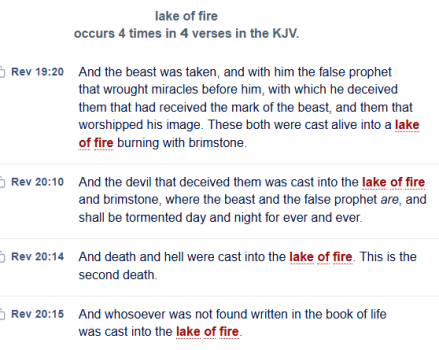
Rev 19:20
And the wild beast was caught, and along with it the false propheth that performed in front of it the signs with which he misled those who received the mark of the wild beasti and those who worship its image.j While still alive, they both were hurled into the fiery lake that burns with sulfur.
Rev 20:10

And the Devil who was misleading them was hurled into the lake of fire and sulfur, where both the wild beastr and the false prophet already were;s and they will be tormented* day and night forever and ever.
Rev 20:14
And death and the Grave* were hurled into the lake of fire.y This means the second death,z the lake of fire
Rev 20:15
Furthermore, whoever was not found written in the book of lifeb was hurled into the
lake of fire.


1775107420628.png
 
  • Like
Reactions: Jack

Pierac

Well-Known Member
Nov 15, 2021
1,007
288
83
63
Phoenix
Faith
Christian
Country
United States
Gender
Male
Translations are just that.... Translations! I will pick one verse and show the different translations in my E-Sword bible.... Now... do make note of the 1st translation (Happens to start with"alt")

Eph 1:11

(ALT) in Him in whom also we were appointed by lot [or, obtained an inheritance], having been predestined according to the purpose [or, plan] of the One supernaturally working all [things] according to the counsel [or, intention] of His will,

(ASV) in whom also we were made a heritage, having been foreordained according to the purpose of him who worketh all things after the counsel of his will;

(BBE) In whom we have a heritage, being marked out from the first in his purpose who does all things in agreement with his designs;

(Bishops) In whom also we are chosen, beyng predestinate accordyng to the purpose of hym who worketh all thynges after the councell of his owne wyll:

(CEV) God always does what he plans, and that's why he appointed Christ to choose us.

(CGNT) TSB=1 : 11 εν αυτω A=1 : 11 εν ω και εκληρωθημεν προορισθεντες κατα προθεσιν του τα παντα ενεργουντος κατα την βουλην του θεληματος αυτου

(CLV) in Him in Whom our lot was cast also, being designated beforehand according to the purpose of the One Who is operating all in accord with the counsel of His will,

(EngSinaiticus) in whom also we have obtained inheritance, being predestinated according to the purpose of him who works all things according to the counsel of his will,

(Coverdale) euen by him, by whom also we are come to the inheritaunce we that were therto predestinate before, acordinge to ye purpose of him, which worketh all thinges after ye councell of his owne wyll,

(Darby) in whom we have also obtained an inheritance, being marked out beforehand according to the purpose of him who works all things according to the counsel of his own will,

(DRB) In whom we also are called by lot, being predestinated according to the purpose of him who worketh all things according to the counsel of his will.

(ESV) In him we have obtained an inheritance, having been predestined according to the purpose of him who works all things according to the counsel of his will,

(ESV+) In him we have obtained an inheritance, having been predestined according to the purpose of him who works all things according to the counsel of his will,

(Geneva) In whom also we are chosen when we were predestinate according to ye purpose of him, which worketh all things after the counsell of his owne will,

(GNB) All things are done according to God's plan and decision; and God chose us to be his own people in union with Christ because of his own purpose, based on what he had decided from the very beginning.

(GDBY_NT) in whom we were also chosen by lot, having been predestinated according to the purpose of him who works all things within us according to the counsel of his own will;

(GW) God also decided ahead of time to choose us through Christ according to his plan, which makes everything work the way he intends.

(KJV) In whom also we have obtained an inheritance, being predestinated according to the purpose of him who worketh all things after the counsel of his own will:

(KJV+) In1722 whom3739 also2532 we have obtained an inheritance,2820 being predestinated4309 according2596 to the purpose4286 of him who worketh1754 all things3956 after2596 the3588 counsel1012 of his own848 will:2307

(KJV-1611) In whom also we haue obteined an inheritance, being predestinated according to the purpose of him who worketh all things after the counsell of his owne will:

(KJVA) In whom also we have obtained an inheritance, being predestinated according to the purpose of him who worketh all things after the counsel of his own will:

(KJVR) In whom also we have obtained an inheritance, being predestinated according to the purpose of him who worketh all things after the counsel of his own will:

(LITV) in whom we also have been chosen to an inheritance, being predestinated according to the purpose of the One working all things according to the counsel of His own will,

(Mace) It is by him, that we have a share in the inheritance, which was before allotted to us, in consequence of his design, who executes the whole plan, as he himself had contriv'd it:

(MKJV) in whom also we have been chosen to an inheritance, being predestinated according to the purpose of Him who works all things according to the counsel of His own will,

(Moffatt NT) in the Christ in whom we have had our heritage allotted us (as was decreed in the design of him who carries out everything according to the counsel of his will),

(MSG) It's in Christ that we find out who we are and what we are living for. Long before we first heard of Christ and got our hopes up, he had his eye on us, had designs on us for glorious living,

(NASB) also we have obtained an inheritance, having been predestined according to His purpose who works all things after the counsel of His will,

(NASB+) also2532 we have obtained2820 an inheritance2820, having been predestined4309 according2596 to His purpose4286 who works1754 all3956 things3956 after2596 the counsel1012 of His will,

(NET.) In Christ we too have been claimed as God's own possession, since we were predestined according to the one purpose of him who accomplishes all things according to the counsel of his will

(NET) In Christ28 we too have been claimed as God's own possession,29 since we were predestined according to the one purpose of him who accomplishes all things according to the counsel of his will

(NIV) In him we were also chosen,[5] having been predestined according to the plan of him who works out everything in conformity with the purpose of his will,

(NKJV) In Him also we have obtained an inheritance, being predestined according to the purpose of Him who works all things according to the counsel of His will,

(NLT) Furthermore, because of Christ, we have received an inheritance from God,[2] for he chose us from the beginning, and all things happen just as he decided long ago.

(Noli) It was our lot to be called to his service, as we were foreordained by the will of God. For he governs the universe in fulfillment of his design,

(nrs) In Christ we have also obtained an inheritance, [3] having been destined according to the purpose of him who accomplishes all things according to his counsel and will,

(nsn+) also2532 we have obtained2820 an inheritance2820 , having been predestined4309 according2596 to His purpose4286 who works1754 all3956 things3956 after2596 the counsel1012 of His will,

(PNT1745) In whom also we have been called; being predestinated according to the purpose of him who worketh all things after the counsel of his own will:

(RNKJV) In whom also we have obtained an inheritance, being predestinated according to the purpose of him who worketh all things after the counsel of his own will:

(Rotherham) In whom also we were taken as an inheritance, according to the purpose of him who energiseth all things according to the counsel of his will,

(rsv) In him, according to the purpose of him who accomplishes all things according to the counsel of his will,

(RV) in whom also we were made a heritage, having been foreordained according to the purpose of him who worketh all things after the counsel of his will;

(Tyndale) that is to saye in him in whom we are made heyres and were therto predestinate accordynge to the purpose of him which worketh all thinges after the purpose of his awne will:

(Vulgate) in quo etiam sorte vocati sumus praedestinati secundum propositum eius qui omnia operatur secundum consilium voluntatis suae

(WEB) in whom also we were assigned an inheritance, having been foreordained according to the purpose of him who works all things after the counsel of his will;

(WAS) in Whom we also were made a heritage, having been predestinated according to the purpose of Him Who worketh all things after the counsel of His own will;

(WycliffeNT) In whom we ben clepid bi sort, bifor ordeyned bi the purpos of hym that worchith alle thingis bi the counsel of his wille;

(YLT) in whom also we did obtain an inheritance, being foreordained according to the purpose of Him who the all things is working according to the counsel of His will,

There are over 50 bibles here and only a few "say... chosen by Lot"

lets add a commentary from the Net Bible!

29 tn Grk "we were appointed by lot." The notion of the verb κληρόω (klēroō) in the OT was to "appoint a portion by lot" (the more frequent cognate verb κληρονομέω [klēronomeō] meant "obtain a portion by lot"). In the passive, as here, the idea is that "we were appointed [as a portion] by lot" (BDAG 548 s.v. κληρόω 1). The words "God's own" have been supplied in the translation to clarify this sense of the verb. An alternative interpretation is that believers receive a portion as an inheritance: "In Christ we too have been appointed a portion of the inheritance." See H. W. Hoehner, Ephesians, 226-27, for discussion on this interpretive issue.

sn God's own possession. Although God is not mentioned explicitly in the Greek text, it is clear from the context that he has chosen believers for himself. Just as with the nation Israel, the church is God's chosen portion or possession (cf. Deu_32:8-9).

Now you can start to begin the understanding of this Topic/Thread.... Who has the truth.... over 50 translation... YET... they do not project the same truth... Suxs to be sure!
 
  • Like
Reactions: St. SteVen

Jack

Well-Known Member
May 3, 2022
15,794
5,939
113
Midwest
Faith
Christian
Country
United States
And many who don't like the main Bible doctrines use this as an excuse to ATTACK the Bible!

I.E Jesus' perfectly clear warnings of THE FIRE. Satan will try anything to hide what Jesus said about THE FIRE! And thus we see many of Satan's messengers in 'Christian' forums trying to convince the gullible that there is no everlasting fire for humans!
 

Taken

Well-Known Member
Feb 6, 2018
29,995
15,757
113
United States
Faith
Christian
Country
United States
--- PARODY TIME ---

KJO reader: This is what the Word of God says.
NIV reader: Let's compare the NIV translation.
KJO reader: WHAT! ??? That's a terrible translation!
NIV reader: Are you saying it isn't the "Word of God"?
KJO reader: The NIV left verses out of the Bible!
NIV reader: No, the NIV kept the same verse numbering system
but left out verses that didn't belong there in the first place.
KJO reader: THEY REMOVED VERSES FROM THE BIBLE !!!!
NIV reader: No, that's not what happened.
KJO reader: Yes it is what HAPPENED !!!
NIV reader: Show me one.
KJO reader: Here you go.
NIV reader: My footnote accounts for that.
KJO reader: Accounts for verses removed from the Bible? ???
NIV reader: The footnote says: It does not appear in any New Testament
manuscript prior to the end of the 6th century.
KJO reader: It's NOT the Word of God !!!!
NIV reader: Seriously?

Interesting that the Bible is "the Word of God", unless someone quotes a translation you disagree with.

Do you do that?

While I prefer one “version”
/ “standard” over another…I think the “core principle”… of establishing an eternal relationship with the Lord God Almighty is Clear and the Top Shelf Point and the impressed Goal for any man to achieve.

The constant hullabaloo is simply, ( like in all things ) an intended distraction to sideline and deflect off the Goal.
 

Pierac

Well-Known Member
Nov 15, 2021
1,007
288
83
63
Phoenix
Faith
Christian
Country
United States
Gender
Male
JW Bible v KJV
Rev 19:20
And the wild beast was caught, and along with it the false propheth that performed in front of it the signs with which he misled those who received the mark of the wild beasti and those who worship its image.j While still alive, they both were hurled into the fiery lake that burns with sulfur.
Rev 20:10

And the Devil who was misleading them was hurled into the lake of fire and sulfur, where both the wild beastr and the false prophet already were;s and they will be tormented* day and night forever and ever.
Rev 20:14
And death and the Grave* were hurled into the lake of fire.y This means the second death,z the lake of fire
Rev 20:15
Furthermore, whoever was not found written in the book of lifeb was hurled into the lake of fire.


View attachment 82420

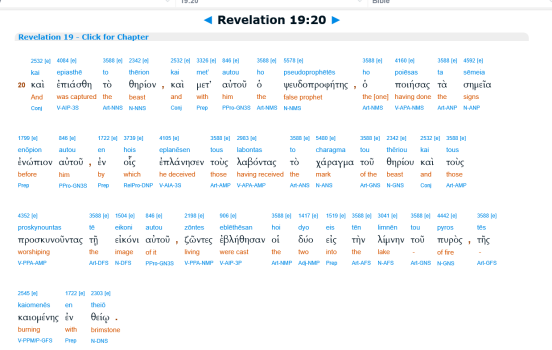
Sorry... not picking on you but the translation you quote... Does scripture really say the word..... "Lake"

Let's really look at this word.....

Rev 19:20 And the beast was seized, and with him the false prophet who performed the signs in his presence, by which he deceived those who had received the mark of the beast and those who worshiped his image; these two were thrown alive into the lake(3041) of fire which burns with brimstone.

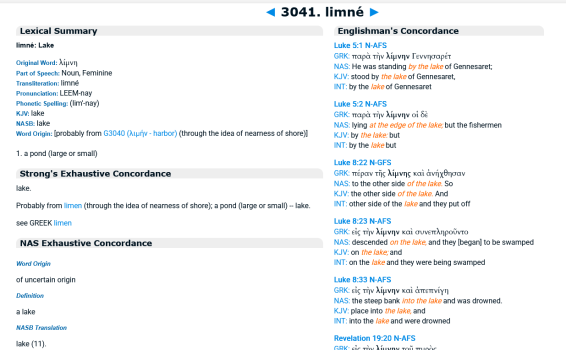
Strongs...
G3041
λίμνη
limnē
lim'-nay
Probably from G3040 (through the idea of the nearness of shore); a pond (large or small): - lake.

WORD STUDY:
G3041
λίμνη
límnē; gen. límnēs, fem. noun from leíbō (n.f.), to pour. Any standing water, pool, lake. Used of the Lake of Gennesareth (Luk_5:1). Used in an absolute sense (Luk_5:2; Luk_8:22, Luk_8:33); of a lake of burning sulfur, meaning Géenna (G1067), Gehenna (Rev_19:20; Rev_20:10, Rev_20:14-15; Rev_21:8; Sept.: Psa_107:35; Psa_114:8).

All were thrown into the pond of Fire!

That's why this Book is "Not literal, but Symbolic"
 
  • Love
Reactions: St. SteVen

Jack

Well-Known Member
May 3, 2022
15,794
5,939
113
Midwest
Faith
Christian
Country
United States
Revelation 19:20 (GenevaBible)
a lake of fire burning with brimstone.
Revelation 19:20 (ASV)
the lake of fire that burneth with brimstone:
Revelation 19:20 (CJB)
the lake of fire that burns with sulfur.
Revelation 19:20 (ESV)
the lake of fire that burns with sulfur.
Revelation 19:20 (HCSB)
the lake of fire that burns with sulfur.
Revelation 19:20 (KJV)
a lake of fire burning with brimstone.
Revelation 19:20 (NASB77)
the lake of fire which burns with brimstone.
Revelation 19:20 (NASB)
the lake of fire which burns with brimstone.
Revelation 19:20 (NIV)
the fiery lake of burning sulfur.
Revelation 19:20 (NKJV)
the lake of fire burning with brimstone.
Revelation 19:20 (NRSV)
the lake of fire that burns with sulfur.
Revelation 19:20 (YLT)
the lake of the fire, that is burning with brimstone;
 

St. SteVen

Well-Known Member
Feb 5, 2023
18,269
6,823
113
71
Minneapolis
Faith
Christian
Country
United States
Revelation 19:20 (GenevaBible)
a lake of fire burning with brimstone.
Revelation 19:20 (ASV)
the lake of fire that burneth with brimstone:
Revelation 19:20 (CJB)
the lake of fire that burns with sulfur.
Revelation 19:20 (ESV)
the lake of fire that burns with sulfur.
Revelation 19:20 (HCSB)
the lake of fire that burns with sulfur.
Revelation 19:20 (KJV)
a lake of fire burning with brimstone.
Revelation 19:20 (NASB77)
the lake of fire which burns with brimstone.
Revelation 19:20 (NASB)
the lake of fire which burns with brimstone.
Revelation 19:20 (NIV)
the fiery lake of burning sulfur.
Revelation 19:20 (NKJV)
the lake of fire burning with brimstone.
Revelation 19:20 (NRSV)
the lake of fire that burns with sulfur.
Revelation 19:20 (YLT)
the lake of the fire, that is burning with brimstone;
1776471914712.png

1. a pond (large or small)

1776471982167.png
 

Pierac

Well-Known Member
Nov 15, 2021
1,007
288
83
63
Phoenix
Faith
Christian
Country
United States
Gender
Male
So... your saying... 90 precent of all humans that have been born and lived... are going into a Lake of fire? POND!

How many Billions in history are going into this Lake of yours... or Pond as I showed you in Strongs"


So the first Adam was decieved by Satan... and 98% still have life out side of God... and the 2nd Adam Jesus (whom is God in the Flesh) Can only muster bout 2% of all humans to follow him to have eternal life....

Satan has bent your GOD over his knee...

BUT not My GOD! My God is ... Love and the savior of all men....

1Ti 4:10 For it is for this we labor and strive, because we have fixed our hope on the living God, who is the Savior of all men, especially of believers.

Who claims more in the END... ? God or Satan....

Your chosing Satan over GOD as having the most souls... and by
Billions!!!


How do you not see the Problem?

Study Harder Jack!!!
 
Last edited:

Jack

Well-Known Member
May 3, 2022
15,794
5,939
113
Midwest
Faith
Christian
Country
United States
So... your saying... 90 precent of all humans that have been born and lived... are going into a Lake of fire? POND!
Nope. STV doesn't believe what Jesus said about Hell Fire! He said "no wonder I don't trust the Bible".
 

Pierac

Well-Known Member
Nov 15, 2021
1,007
288
83
63
Phoenix
Faith
Christian
Country
United States
Gender
Male
Nope. STV doesn't believe what Jesus said about Hell Fire! He said "no wonder I don't trust the Bible".

Yes... my post is long Jack... It's the narrow path... wide and easy is your tik tok!


1. Reframing “Salvation” in Scripture

A strictly text-driven reading of Scripture suggests that “salvation” is not primarily framed as escape from an eternal heaven/hell binary, but as deliverance from death, corruption, and exile from life. From the opening chapters of Genesis, the consequence of sin is not eternal torment but mortality“dust you are, and to dust you shall return.” This trajectory continues throughout the biblical narrative.

Paul’s summary in Romans—“the wages of sin is death”—is not an isolated theological statement but a direct continuation of this pattern. Likewise, in 1 Corinthians 15, salvation is presented almost entirely in terms of resurrection, not post-mortem relocation to heaven. Death is the enemy; life restored is the victory.

If eternal conscious torment were central to the biblical framework, one would expect explicit articulation in the Torah or clear covenantal warnings tied to it. Instead, Scripture consistently emphasizes:

  • Historical covenant consequences
  • Death as the ultimate curse
  • Restoration through resurrection

This strongly supports the conclusion that “being saved” fundamentally means being rescued from death and brought into restored life.

2. The Kingdom of God as the Central Gospel


Jesus’ proclamation is not centered on “going to heaven,” but on the arrival of the Kingdom of God. His message is consistent:

  • “Repent, for the Kingdom of God is at hand.”
  • “Blessed are the meek, for they shall inherit the earth.”
  • “Your will be done on earth as it is in heaven.”

Even after the resurrection, the disciples ask about the restoration of the kingdom (Acts 1:6), and Jesus does not correct the premise—only the timing.

The implication is clear:
The early Christian hope was not disembodied existence, but resurrection, inheritance, and participation in a restored creation under God’s reign.

3. Resurrection and the Structure of Redemption

Revelation 20 introduces a layered eschatology:

  • First resurrection → participation in Christ’s reign
  • Second resurrection → judgment

This structure only makes sense if salvation is understood as restored life within God’s Kingdom, not simply relocation to heaven. If salvation were merely “going to heaven,” resurrection would be unnecessary. Instead, resurrection is central because it restores embodied life within a renewed creation.

4. The Language of “Hell” and Its Development


The biblical terminology often translated as “hell” reflects a range of meanings that do not inherently imply eternal torment:

  • Sheol / Hades: the realm of the dead, not a place of punishment
  • Gehenna: a historical symbol of covenant judgment rooted in the Valley of Hinnom
  • Tartarus: a temporary holding place for spiritual beings
None of these terms, in their original linguistic and cultural contexts, clearly denote an eternal torture chamber. That concept emerges later through translation traditions and theological synthesis, not from the Hebrew or Greek texts themselves.

5. “Eternal” as Age-Related, Not Infinite


The biblical terms often translated as “eternal” (Hebrew olam, Greek aion, aionios) are better understood as referring to ages or age-related realities, not necessarily endless duration.

This distinction matters. An “age-lasting” judgment:

  • Preserves divine justice
  • Allows for correction and restoration
  • Aligns with God’s stated desire that all be saved
An endless punishment with no restorative purpose introduces tension with the broader biblical portrayal of God’s character and intentions.

6. The Nature of Judgment

Biblically, judgment is consistently portrayed as restorative and corrective, not merely punitive. The Hebrew concept of mishpat and the Greek krisis both carry the sense of setting things right.

Scripture repeatedly presents divine discipline as purposeful:

  • God’s anger is temporary
  • His mercy endures
  • Judgment leads to learning righteousness (Isaiah 26:9)

Even images such as fire are frequently associated with purification, not destruction for its own sake.

7. The Question of Final Restoration

The idea that God ultimately restores all things is not sentimental—it arises from internal biblical logic. Texts such as Romans 11:32 (“God has consigned all to disobedience, that He may have mercy on all”) present a vision in which divine judgment and mercy are not opposed but sequential and integrated.

Rejecting this trajectory typically requires assuming:
  1. God’s purposes ultimately fail
  2. God eternally wills division
  3. Justice permanently overrides mercy
Each of these positions introduces tension with the broader narrative arc of Scripture.

8. Second Temple Jewish Context

This framework aligns closely with the worldview of Second Temple Judaism, the environment in which both Jesus and Paul operated. That worldview emphasized:
  • Resurrection as the central hope
  • The coming Kingdom of God
  • Restoration of creation
  • Age-based history (this age vs. the age to come)
  • Judgment as covenantal correction

Within this context:
  • Gehenna was commonly understood as temporary and purifying
  • Resurrection preceded final judgment
  • The ultimate goal was God’s victory over death and evil
While universal restoration was not universally held, it was present as a minority but legitimate stream within Jewish thought.

9. Jesus and Gehenna in Context

When Jesus speaks of Gehenna, he is operating within this existing Jewish framework. His warnings are severe, but they do not redefine Gehenna into an eternal torture realm.

Key features of his teaching include:
  • Use of prophetic and hyperbolic language
  • Emphasis on moral urgency
  • Focus on accountability and transformation

Terms such as “fire,” “destruction,” and “unquenchable” reflect irresistible and thorough judgment, not necessarily endless duration. His audience would have understood these images as serious but corrective.

10. Coherence of the Kingdom Framework

When the biblical narrative is read through this lens, its internal coherence becomes clearer:
  • Death is the central problem
  • Resurrection is the solution
  • The Kingdom is the goal
  • Judgment is the process
  • Restoration is the outcome
This framework preserves:
  • The seriousness of judgment
  • The necessity of repentance
  • The centrality of Christ’s reign
  • The ultimate defeat of death
Final Synthesis

A non-biased, textually grounded reading of Scripture supports the conclusion that:
  • “Salvation” fundamentally means rescue from death and corruption
  • The biblical hope is resurrection and participation in the Kingdom of God
  • Judgment is real, severe, and purposeful
  • The language of “hell” does not require eternal torment
  • God’s redemptive purpose moves toward restoration

In this vision, the gospel is not weakened but strengthened. It presents a reality in which:
  • Death is truly defeated
  • Justice is meaningfully enacted
  • Mercy is ultimately fulfilled
  • And God’s purposes reach their intended completion

 
  • Love
Reactions: St. SteVen

Jack

Well-Known Member
May 3, 2022
15,794
5,939
113
Midwest
Faith
Christian
Country
United States
Hell will be filled with BILLIONS of humans who don't believe in Hell. FOREVER!

Jesus said so.