Shalom, daq.
daq said:
What are you talking about? It seems you are willing to make things up to support your own conclusions:
Galatians 4:26 TUA (Transliterated Unaccented Bible)
26. He de ano Ierousalem eleuthera estin, hetis estin meter {*}hemon,
Galatians 4:26 LIT (Literal Bible with Strong's Vertical Ref.#s)
26.
|3588| the
|1161| But
|0507| above
|2419| Jerusalem
|1658| free
|2076| is,
|3748| who
|2076| is
|3384| mother
|2257| of us.
Original Strong's Ref. #507
Romanized ano
Pronounced an'-o
adverb from GSN0473; upward or on the top:
KJV--above, brim, high, up.
"Jerusalem of above" is not "an unfortunate word used for translation of anoo" but rather exactly what the text states.
John 8:21-23 KJV
21. Then said Jesus again unto them, I go my way, and ye shall seek me, and shall die in your sins: whither I go, ye cannot come.
22. Then said the Jews, Will he kill himself? because he saith, Whither I go, ye cannot come.
23. And he said unto them, Ye are from beneath; I am from above: [GSN#507 ano] ye are of this world; I am not of this world.
24. I said therefore unto you, that ye shall die in your sins: for if ye believe not that I am he, ye shall die in your sins.
Anothen comes from ano and means exactly "from above" as employed in the famous John 3 passage:
John 3:3 LIT
3.
|0611| answered
|2424| Jesus
|2532| and
|2036| said
|0846| to him,
|0281| Truly,
|0281| truly,
|3004| I say
|4671| to you,
|3362| Except
|5100| one
|1080| receive birth
|0509| from above,
|3756| not
|1410| he is able
|1492| to see
|3588| the
|0932| kingdom
|3588| of
|2316| God!
Original Strong's Ref. #509
Romanized anothen
Pronounced an'-o-then
from GSN0507; from above; by analogy, from the first; by implication, anew:
KJV--from above, again, from the beginning (very first), the top.
Shall we now alter the theological foundation of what it means to be "born from above" so as to suit your theories?
The Testimony of Yeshua is the Spirit of prophecy! :)
. . .
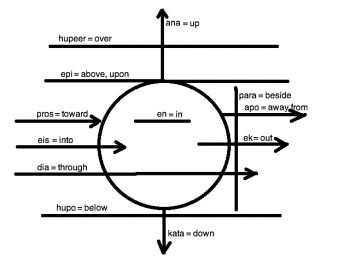
Granted, I was feeling tired and skipped a few steps. I was talking about the prepositions:
NT:507
anoo (an'-o); adverb from NT:473;
upward or
on the top:
KJV - above, brim, high, up.
NT:473
anti (an-tee'); a primary particle;
opposite, i.e.
instead or
because of (rarely
in addition to):
KJV - for, in the room of. Often used in composition to denote contrast, requital, substitution, correspondence, etc.
NT:303
ana (an-ah'); a primary preposition and adverb; properly,
up; but (by extension) used (distributively)
severally, or (locally)
at (etc.):
KJV - and, apiece, by, each, every (man), in, through. In compounds (as a prefix) it often means (by implication) repetition, intensity, reversal, etc.
NT:1909
epi (ep-ee'); a primary preposition; properly, meaning
superimposition (of time, place, order, etc.), as a relation of distribution [with the genitive case], i.e.
over,
upon, etc.; of rest (with the det.)
at,
on, etc.; of direction (with the accusative case)
towards,
upon, etc.:
KJV - about (the times),
above, after, against, among, as long as (touching), at, beside, X have charge of, (be-, [wherefore-]), in (a place, as much as, the time of, -to), (because) of, (up-) on (behalf of), over, (by, for) the space of, through (-out), (un-) to (-ward), with. In compounds it retains essentially the same import, at, upon, etc. (literally or figuratively).
(Biblesoft's New Exhaustive Strong's Numbers and Concordance with Expanded Greek-Hebrew Dictionary. Copyright © 1994, 2003, 2006 Biblesoft, Inc. and International Bible Translators, Inc.)
View attachment 151
In hindsight, I believe that we may have found an error in Strong's Greek-Hebrew Dictionary. "
Anoo" is more likely to be an adverb from "
ana" (NT:303) instead of from "
anti" (NT:473), just as "
katoo" is an adverb derived from "
kata." That would make better sense.
NT:2736
katoo (kat'-o); also (compare)
katooteroo (kat-o-ter'-o); [compare NT:2737];
adverb from NT:2596;
downwards:
KJV - beneath, bottom, down, under.
NT:2596
kata (kat-ah'); a primary particle; (prepositionally)
down (in place or time), in varied relations (according to the case [genitive case, dative case or accusative case] with which it is joined):
KJV - about, according as (to), after, against, (when they were) X alone, among, and, X apart, (even, like) as (concerning, pertaining to touching), X aside, at, before, beyond, by, to the charge of, [charita-] bly, concerning, + covered, [daily-], down, every, (+far more) exceeding, X more excellent, for, from ... to, godly, in (-asmuch, divers, every, -to, respect of), ... by, after the manner of, + by any means, beyond (out of) measure, X mightily, more, X natural, of (up-) on (X part), out (of every), over against, (+your) X own, + particularly, so, through (-oughout, -oughout every), thus, (un-) to (-gether, -ward), X uttermost, where (-by), with. In composition it retains many of these applications, and frequently denotes opposition, distribution, or intensity.
(Biblesoft's New Exhaustive Strong's Numbers and Concordance with Expanded Greek-Hebrew Dictionary. Copyright © 1994, 2003, 2006 Biblesoft, Inc. and International Bible Translators, Inc.)
So, I apologize for bringing "
anoo" to question. You were right about that word; I was wrong. I trusted too heavily on Strong's and should have researched it better.



 r 12:2 looking unto Jesus, the author and finisher of [our] faith, who for the joy that was set before Him endured the cross, despising the shame, and has sat down at the right hand of the throne of God.
 h34r:
h34r: