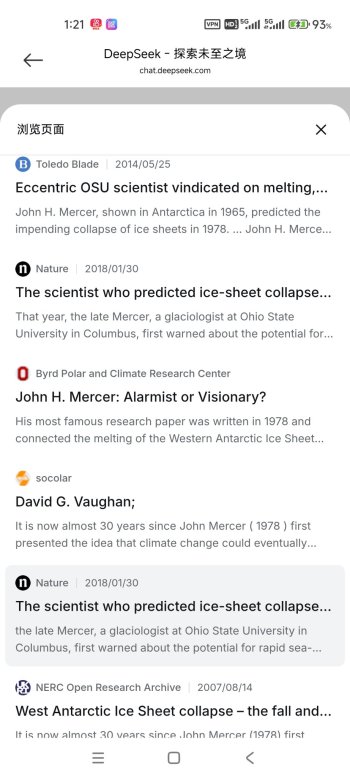
John H. Mercer was a brilliant and far-sighted glaciologist. His core theory—the collapse of "Earth's immune system"—paints a picture of a catastrophic and potentially interconnected apocalypse triggered by global warming, centered on **the collapse of the West Antarctic Ice Sheet, the breakdown of marine ecosystems, and the eruption of seabed methane hydrates**.
### John H. Mercer: The Doomsday Prophet Overlooked by His Era
John H. Mercer (1922–1987) was a glaciologist at Ohio State University, renowned for his groundbreaking research on the instability of the Antarctic ice sheet. His predictions, fiercely controversial at the time, are being validated one after another today.
* **Core Prediction: Ice Sheet Collapse and Sea Level Surge**: In 1978, Mercer published a paper in *Nature* warning that the West Antarctic Ice Sheet was "uniquely vulnerable and unstable" due to its peculiar geography—a "bowl-shaped" bedrock largely below sea level. He predicted that under global warming, the ice sheet would be eroded by warm ocean water, melting from below and then disintegrating rapidly, ultimately causing global sea levels to rise **by about 5 to 6 meters (16 to 20 feet)**. This disaster would unleash worldwide mass flooding and chaos. Science now confirms that ice loss in the Amundsen Sea region of West Antarctica has become "unstoppable," validating Mercer's forecast.
* **A Theory Named After Him: The "John Mercer Effect"**: Renowned climate scientist James Hansen coined the term **"John Mercer effect"** to describe the collective cautious behavior in the scientific community, where researchers tend to downplay the risks of climate change for fear of being branded "alarmists" and losing funding. Mercer himself experienced this, facing widespread rejection of his papers and the slashing of his research grants.
### Marine Ecosystems: The "Deadly Trio" Driving Collapse
The ice sheet melt Mercer predicted ultimately injects freshwater into the ocean. But today, the oceans face an even more urgent **"deadly trio"**—global warming, acidification, and deoxygenation—that together are pushing marine ecosystems to the brink.
| Threat Type | Main Cause | Deadly Impact on Marine Ecosystem |
| :--- | :--- | :--- |
| *

Global Warming (Marine Heatwaves)** | Greenhouse gas emissions cause oceans to absorb massive heat, leading to a sustained rise in sea surface temperatures. | Causes mass coral bleaching and mortality, destroying reef ecosystems; forces fish and other species to migrate toward colder waters, altering ecosystem structure; intensifies ocean stratification, hindering the upwelling of deep-water nutrients. |
| ** Ocean Acidification** | Oceans absorb roughly a quarter of anthropogenic CO₂, which reacts with water to form carbonic acid, altering seawater chemistry. | Directly corrodes the calcium carbonate shells and skeletons of calcifying organisms (e.g., shellfish, plankton), making survival difficult and undermining the base of the entire marine food web. |
| ** Ocean Deoxygenation (Dead Zones)** | First, **warmer water itself holds less dissolved oxygen**. Second, **rapid surface warming intensifies stratification**, blocking the mixing of oxygen-rich surface water with deeper layers. | Creates vast anoxic "dead zones," forcing aerobic organisms like fish to flee or die; disrupts the biological pump, accelerating decomposition that consumes even more oxygen, forming a vicious cycle. |
This "trio" is not merely hypothetical. During the **Permian-Triassic extinction event** and the **Cretaceous Oceanic Anoxic Events**, episodes of massive global warming, acidification, and deoxygenation coincided with mass extinctions of marine life—strikingly similar to today's trends. Its vicious cycle pathway is:
**Rising CO₂ → Ocean warming & acidification → Intensified stratification → Disruption of deep-ocean oxygen supply → Expansion of anoxic dead zones → Mass extinction of marine life → Weakening of the oceanic carbon pump → Accelerated climate deterioration**.
### Subsea Methane Hydrates: The Sleeping "Methane Monster" and Ecological Catastrophe
Subsea methane hydrates (technically gas hydrates) are a vast potential energy source. Their primary component, **methane**, is a greenhouse gas **24 to 25 times** more potent than carbon dioxide over a century.
* **An Indirect Doomsday Amplifier**: The eruption of methane hydrates is seen largely as a **multiplier and catalyst** within Mercer's predictions. As global warming raises ocean temperatures, it can destabilize the enormous quantities of frozen methane on the seafloor, causing them to decompose. Massive methane release would dramatically accelerate climate warming, further promote polar ice sheet melting, make sea-level rise far more abrupt, and worsen ocean acidification, deoxygenation, and biological extinction.
* **A Direct "Geological Catastrophe"**: The decomposition of hydrates itself could also trigger immense direct geological disasters. It significantly reduces the mechanical stability of seabed sediments, potentially causing **massive submarine landslides, slumps, and even tsunamis**.
Mercer once predicted that a doubling of CO₂ concentration would trigger the collapse of the West Antarctic Ice Sheet. Today, CO₂ levels have reached about 420 ppm, far exceeding his warning threshold. Global warming is pushing the ice sheets, the ocean, and methane hydrates—elements of this "Earth's immune system"—closer to the brink. Mercer's once-ignored doomsday trilogy is now being validated, step by step, through a chain of vicious cycles confirmed by science.