Genesis 3:15 is one of the most famous passages in Scripture, since it offers the first, veiled prophecy of the coming of the Messiah. But confusion results fro...

www.catholic.com
"Genesis 3:15 is one of the most famous passages in Scripture, since it offers the first, veiled prophecy of the coming of the Messiah. But confusion results from differing translations of the passage.
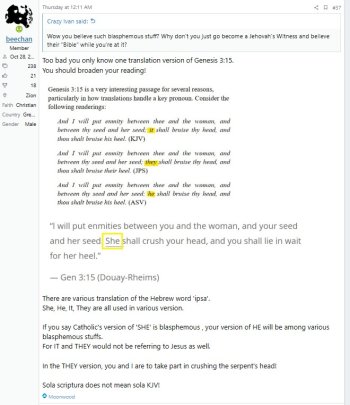
In most editions of the Douay-Rheims Bible—the Catholic counterpart to the King James Version—Genesis 3:15 says, “I will put enmities between thee [the serpent] and the woman, and thy seed and her seed:
she shall crush thy head, and thou shalt lie in wait for
her heel.”
In the New American Bible, and all other modern Bibles, it says, “I will put enmity between you and the woman, and between your offspring and hers;
he will strike at your head, while you strike at
his heel.”
The difference turns on who will crush the serpent’s head and whom the serpent tries to strike. The Douay-Rheims uses feminine pronouns—”she” and “her”—implying that the
woman is the person being described. Modern translations use masculine pronouns—”he” and “his”—implying that
the seed of the woman is the serpent-crusher.
This disparity results from a manuscript difference.
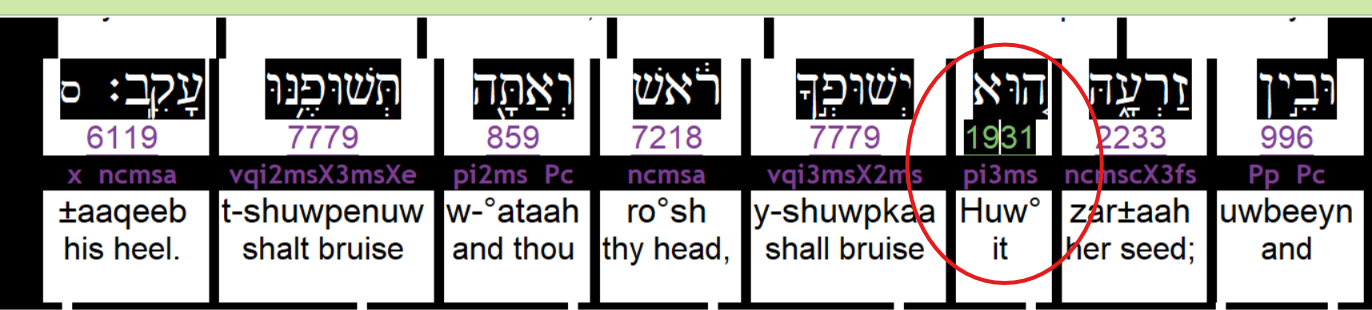
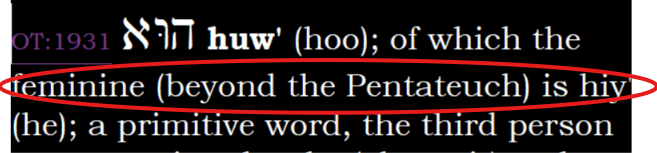
Modern translations follow what the original Hebrew of the passage says. The
Douay-Rheims follows a textual variant found in many early Fathers and some editions of the Vulgate, though not the original. Jerome followed the Hebrew of this text in his edition of the Vulgate.
The variant probably originated as a copyist’s error, when a scribe failed to note that the subject of the verse had shifted from the woman to the seed of the woman."
So Catholic Answers says that the Douay-Rheims translation doesn't follow the original Hebrew, but follows a variant that probably came about through a copyist's error.
It then goes on to say, well....Mary, because she was the mother of Jesus, still crushed the serpent's head because it was her seed that did it, blah blah blah. But the point here is that even Catholic Answers understands that the Douay-Rheims translation has it wrong and mistranslating from a copyists error from the original.
So yeah, let's rely on a mistranslated version of Gen 3:15 to claim that Mary was the one who crushed the serpent's head. And let's rely on a forged protoevangelium of James that contains no fewer than three direct contradictions of Scripture and was condemned by Pope Innocent in 405 to argue for the immaculate conception of Mary.
The real problem here is the whole idea that the Catholic Church can never err. So when it DOES err, either the CC has to correct it and admit error (which undermines the entire premise), or it has to cling to, and even double down on, the error. Like, if you read the "infallible" dogma of 1950 on the assumption of Mary, it's massively based on the 1854 dogma on the immaculate conception. And I've shown numerous errors in the 1854 dogma, but once it's there, the CC is stuck. It's committed to the bit and it has to see it through.
This is how you end up with compounded errors. The reformers, for all the flaws that they had - and they were numerous - tried to actually CORRECT wrongs instead of saying, hey, we don't make errors so don't question us.