OT Grammarian proof of Trinity

  • Welcome to Christian Forums, a Christian Forum that recognizes that all Christians are a work in progress.

    You will need to register to be able to join in fellowship with Christians all over the world.

    We hope to see you as a part of our community soon and God Bless!

Pavel Mosko

Active Member
Dec 19, 2021
276
120
43
58
Boyertown
Faith
Christian
Country
United States
Gender
Male
Greetings again Pavel Mosko,

As well as his unusual explanation of Psalm 110, especially Psalm 110:5 in those years he also participated in a debate, but did not allow a discussion on the gradual development of the Trinity despite the fact that the person who debated him DB invited him to discuss this.

I have listened to a lecture given by DB on this subject about the same time and the following is taken from one of his slides.

Justin Martyr (2nd Century)
The Father alone is ‘true God’; Jesus is a pre-existent divine being created by God; the Holy Spirit is a type of angel

Irenaeus of Lyons (2nd Century)
The Father alone is ‘true God’; the Son and Holy Spirit are the divine ‘hands of God’, but not fully God in their own right

Tertullian (2nd-3rd Centuries)
Father, Son and Holy Spirit all share the same essence and co-exist equally as God, yet the Son was somehow ‘begotten’ by the Father and there was a time when he did not exist

Origen (2nd-3rd Centuries)
The Father alone is ‘very God’; the Son has always existed, being eternally ‘generated’ by Him; the Holy Spirit’s divinity is derived from the Son

Clement of Alexandria (2nd-3rd Centuries)
The Father alone is God; Jesus and the Holy Spirit are pre-existent divine beings created by Him

Arius (3rd-4th Centuries)
Jesus is the first of God’s creation; a pre-existent divine being

Athanasius (3rd-4th Centuries)
Father, Son and Holy Spirit are equally God; Jesus was and still is, fully God and fully man

Council of Nicaea (AD 325)
Officially declares Jesus is fully God, equal to the Father

Council of Constantinople (AD 381)
Officially declares Father, Son and Holy Spirit are all equally God

Kind regards
Trevor
Greetings Trevor,
Right now I’ve got family activities going on — we’re giving my dad an early 90th birthday party — so I’ll keep this focused on one key point for now and circle back to others later.
You mentioned Justin Martyr describing the Holy Spirit or Jesus in angelic terms. That’s a fair observation from the slide, but the Angel of the Lord in Scripture (and how Justin read Him) is very different from a regular created angel. This ties directly into the Two Powers in Heaven concept from Second Temple Judaism that I referenced earlier.

Quick summary of Two Powers in Heaven (per Michael Heiser and the biblical data):​

In the Hebrew Bible, Yahweh is portrayed as both invisible/transcendent (the sovereign in heaven) and visible/immanent (appearing on earth in human form to interact with people). This isn’t ditheism or two gods — it’s one God in two related “presences” or powers.
  • Key texts: The Angel of the Lord (Exodus 3 — burning bush: “The Angel of the Lord appeared... and God called to him from the bush”; Judges 13; Genesis 16, 18, etc.) speaks and acts as Yahweh Himself (accepts worship, forgives sin, bears the divine Name, etc.), yet is sent by Yahweh. He’s not a created messenger like Gabriel or Michael.
  • Other “weird observations”: The Name-Bearer (Exodus 23:20-21 — “My Name is in him”), the visible Yahweh who eats with Abraham (Genesis 18), the Cloud Rider (Daniel 7’s Son of Man), and Memra/Word traditions in the Targums.
  • Ancient Jews (pre-rabbinic) had room for this “second Yahweh” figure as a divine vice-regent or visible embodiment of the invisible God — rooted in the divine council worldview. Later rabbis labeled it heretical (around the 2nd century CE) partly in reaction to Christians identifying this second Power with Jesus.
Justin Martyr (in Dialogue with Trypho 56–62) explicitly uses these passages to show the pre-existent Son/Logos as the visible Yahweh who appeared to the patriarchs — the one who is both “God and Lord” and sent by the Father. He’s not demoting Jesus to a regular angel; he’s identifying Him with this ancient Jewish “second Power” who shares the divine identity while remaining distinct. That fits the progressive revelation you raised: the OT gives the raw “weird” data, the apostles and earliest fathers connect the dots after the incarnation and resurrection.
This Jewish background makes the high Christology in the Apostolic Fathers (Ignatius calling Jesus “our God,” triadic worship formulas, etc.) feel continuous rather than a sudden Hellenistic import.
I’ll try to address more of the slide points after the family stuff settles. In the meantime, curious what you make of the Angel of the Lord passages where He is treated as Yahweh Himself?
Kind regards, Pavel
 

TrevorHL

Active Member
Jul 17, 2024
627
175
43
82
New South Wales / Lake Macquarie
Faith
Christian
Country
Australia
Gender
Male
Greetings again Pavel Mosko,
curious what you make of the Angel of the Lord passages where He is treated as Yahweh Himself?
The Angel of Yahweh is an Angel of Yahweh, a messenger of Yahweh, who represents Yahweh and acts on his behalf. There are a number of these and two examples would be Michael and Gabriel.

Jude identifies the particular Angel of Yahweh in Zechariah 3 as Michael.

Zechariah 3:1–2 (AV): 1 And he shewed me Joshua the high priest standing before the angel of the LORD, and Satan standing at his right hand to resist him. 2 And the LORD said unto Satan, The LORD rebuke thee, O Satan; even the LORD that hath chosen Jerusalem rebuke thee: is not this a brand plucked out of the fire?

Jude 8–9 (AV): 8 Likewise also these filthy dreamers defile the flesh, despise dominion, and speak evil of dignities. 9 Yet Michael the archangel, when contending with the devil he disputed about the body of Moses, durst not bring against him a railing accusation, but said, The Lord rebuke thee.


Kind regards
Trevor
 

Episkopos

Well-Known Member
May 17, 2011
14,474
21,734
113
67
Montreal
Faith
Christian
Country
Canada
Gender
Male
What is not being understood in this study is that when the Hebrew is plural, without specifying the number being discussed, the number is always 2 (not 3 or any other number). The Godhead is Father and Son united in One Spirit. Jesus said "I and My Father are One" One what? One God, One Spirit.
 

TrevorHL

Active Member
Jul 17, 2024
627
175
43
82
New South Wales / Lake Macquarie
Faith
Christian
Country
Australia
Gender
Male
Greetings Episkopos,
What is not being understood in this study is that when the Hebrew is plural, without specifying the number being discussed, the number is always 2 (not 3 or any other number).
Elohim is applied to the Angels and Judges and in these instances can represent many more than 2 or 3. Please check your Hebrew.

Kind regards
Trevor
 

Grailhunter

Well-Known Member
Jun 19, 2019
14,389
6,213
113
69
FARMINGTON
Faith
Christian
Country
United States
Gender
Male
  • Deuteronomy 6:4 – “Hear, O Israel: The LORD our God, the LORD is one.
  • Deuteronomy 32:39 See now that I, even I, am he, and there is no god beside me; I kill and I make alive; I wound and I heal; and there is none that can deliver out of my hand.
  • Isaiah 44:6 Thus says the Lord, the King of Israel and his Redeemer, the Lord of hosts: “I am the first and I am the last; besides me there is no god.
  • Isaiah 45:5 – “I am the LORD, and there is no other; there is no God but Me”
  • Isaiah 46:9 Remember the former things of old; for I am God, and there is no other; I am God, and there is none like me,
  • Psalm 86:10 – “For you are great and do marvelous deeds; you alone are God”

And Yeshua explained the oneness concept. But few pay attention to that.
The New Testament Yeshua gives us a clearer explanation of the oneness concept. Speaking to God the Father (He was not talking to Himself) Yeshua says this about the concept of one...John 17:22 “And the glory which to them; that they may be one just as We are one.” Because Yeshua says “just as” this is an exactness, a duplication of a condition that we can achieve, and He states that this condition of “oneness” can apply to us, but it has nothing to do with absorption or singularity, but rather a condition of spiritual union and solidarity between God and us. The next verse further defines this by describing a unity with Christ that would cause the same condition with us as it did with them, a condition of perfection. Again, not talking to Himself, in John 17:23 “I in them, and You in Me, that they may be perfected in unity, that the world may know that You did send Me, and do love them, even as you do love Me.” In this context millions of people could be made one...one being a abstract concept of one, but a more literal meaning of unity, solidarity, and perfection and even a “body” that is considered one....the body of Christ or the body of the Church. And then, the next verse is probably one of the best verses to put this oneness concept into perspective. The leading verses are speaking of the works of the Holy Spirit and then ends with this explanation. 1st Corinthians 12:11-13 “But one and the same Spirit works all these things, distributing to each one individually just as He wills. For even as the body is one and yet has many members, and all the members of the body, though they are many, are one body, so also is Christ. For by one Spirit we were all baptized into one body, whether Jews or Greeks, whether slaves or free, and were all made to drink of one Spirit. For the body is not one member, but many.”.....So the "Oneness" is something that applies or will apply to all of us and we are not gods nor will we ever be gods.

But still the number thing can be misleading, in relation to Yahweh....God supreme, God Almighty. His being, maybe vast.....Every atom in the universe may have part of Him in it.
And whether or not if you believe in the 3 in 1 formula for the Trinity or that the Trinity is made up of a Godhead of 3 Gods, that is not to say they do not have a divine connection. Yeshua said that Yahweh knew when the end of time was and He did not. So they have different minds and Yeshua sits on the right hand of Yahweh....But what would 3 perfect minds be like? 3 perfect minds would think exactly the same. Just like 3 exact computers would commutate exactly the same. And I am sure there is divine unity that we cannot comprehend. In fact that is what Trinity means....Tri-unity, not Tri-one. The one God of the Old Testament impregnated a woman and what she delivered was a God....the Savior of the world. The Son of God.
 

Grailhunter

Well-Known Member
Jun 19, 2019
14,389
6,213
113
69
FARMINGTON
Faith
Christian
Country
United States
Gender
Male
Greetings Grailhunter,

Many words leading up to your final statement. What Mary delivered was a human, the Son of God.

Kind regards
Trevor

Actually what the physical / divine nature of what exactly Yeshua was when He walked on earth has been debated for centuries. His existence was so unique, I do not know if we have a word for it. Some say 100% human and 100% God. Some say His body was human and His spirit was divine. I call Him a God.
 

shepherdsword

Encounter Team - Eagle
Staff member
Encounter Team
Feb 12, 2009
2,042
1,641
113
Millington
Faith
Christian
Country
United States
Gender
Male
This was my first big Grok experiment over a year ago. I've studied all kinds of Trinitarian Biblical arguments and scriptures, but Biblical languages were never my strong suit getting a B- in Greek and a C- in Hebrew at Fuller Theological Seminary almost 30 years ago. So, I was curious about the ability to use Grok to cover that weak area.


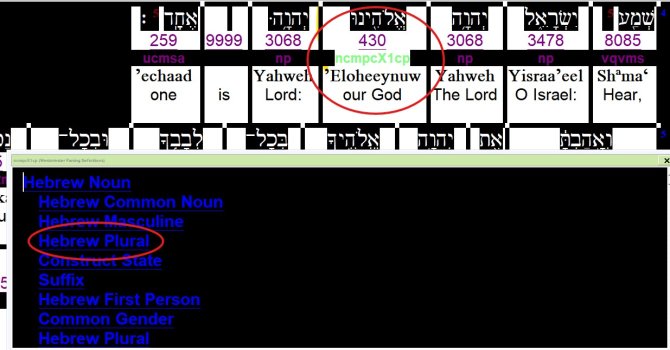
View attachment 85383

Grok Trinity Grammar Experiment from the Old Testament grammar. Here it is verbatim from my specific inquiry.
"Let’s dive into the fascinating world of Old Testament Hebrew and Aramaic to explore grammatical hints of the Trinity. While the doctrine of the Trinity—God as Father, Son, and Holy Spirit—is most explicitly developed in the New Testament, some scholars point to subtle clues in the Old Testament’s language that suggest a plurality within God’s unity. I’ll focus on key verses, their grammar, and how they’ve been interpreted, sticking to the texts in their original languages.

Genesis 1:1-2 – Plurality in Creation
Start with Genesis 1:1: "בְּרֵאשִׁית בָּרָא אֱלֹהִים אֵת הַשָּׁמַיִם וְאֵת הָאָרֶץ" ("In the beginning, God created the heavens and the earth"). The word for "God" here is Elohim (אֱלֹהִים), a grammatically plural noun. In Hebrew, the suffix -im typically indicates plurality (e.g., cherubim, seraphim). Yet, the verb bara (בָּרָא, "created") is singular, third-person masculine singular. This is striking: a plural noun paired with a singular verb.
In isolation, Elohim can refer to plural "gods" (e.g., Exodus 20:3), but in Genesis 1, context and Jewish tradition treat it as referring to the one God. Some Trinitarian scholars argue this plural form hints at a complex unity—God is one in essence (singular verb) but has a plurality in persons (plural noun). Then, in Genesis 1:2, we see the "Spirit of God" (רוּחַ אֱלֹהִים, Ruach Elohim) hovering over the waters, suggesting a distinct yet connected aspect of God’s being, active in creation.

Genesis 1:26 – "Let Us Make"
Move to Genesis 1:26: "וַיֹּאמֶר אֱלֹהִים נַעֲשֶׂה אָדָם בְּצַלְמֵנוּ כִּדְמוּתֵנוּ" ("And God said, ‘Let us make man in our image, according to our likeness’"). Here, Elohim (plural) speaks, and the verb na’aseh (נַעֲשֶׂה, "let us make") is first-person plural, as are the pronouns "our image" (בְּצַלְמֵנוּ) and "our likeness" (כִּדְמוּתֵנוּ). This isn’t the royal "we"—that’s a later convention not native to ancient Hebrew.
Jewish interpretations often suggest God is consulting His heavenly court (angels), but angels don’t create or share God’s image. The plural language could imply a deliberation within God Himself, a hint of multiple persons in the Godhead. In Genesis 1:27, it reverts to singular: "וַיִּבְרָא אֱלֹהִים אֶת־הָאָדָם בְּצַלְמוֹ" ("So God created man in His image"), reinforcing one God acting, yet the prior "us" lingers as a grammatical anomaly pointing to plurality.

Isaiah 48:16 – A Speaker and a Sender
In Isaiah 48:16, we get: "קִרְבוּ אֵלַי שִׁמְעוּ־זֹאת... וְעַתָּה אֲדֹנָי יְהוִה שְׁלָחַנִי וְרוּחוֹ" ("Draw near to me, hear this... and now the Lord YHWH has sent me, and His Spirit"). The Hebrew grammar is intriguing. The speaker (first-person "me") claims to be sent by "the Lord YHWH" (אֲדֹנָי יְהוִה) along with "His Spirit" (וְרוּחוֹ). The verb shalachani (שְׁלָחַנִי, "has sent me") is singular, with the suffix -ni indicating "me" as the object.
Who is this "me"? Some see it as the prophet Isaiah, but the context (verses 12-16) aligns with the Servant of YHWH, often linked to the Messiah in Christian theology. Here, we have three entities: the Lord YHWH (the sender), the "me" (the sent one), and the Spirit. The grammar doesn’t demand a Trinity, but it allows for a distinction of persons within God’s actions, a pattern Trinitarians find significant.
Deuteronomy 6:4 – Unity Amid Plurality

The Shema in Deuteronomy 6:4 says: "שְׁמַע יִשְׂרָאֵל יְהוִה אֱלֹהֵינוּ יְהוִה אֶחָד" ("Hear, O Israel: YHWH our God, YHWH is one"). Eloheinu (אֱלֹהֵינוּ, "our God") is plural with a first-person plural suffix ("our"), yet echad (אֶחָד, "one") emphasizes unity. Echad can mean a compound unity (e.g., Genesis 2:24, "two become one flesh"), unlike yachid (absolute singularity, used elsewhere like Genesis 22:2).
While this verse stresses monotheism, the plural Elohim-derived form alongside echad leaves room for a unified plurality. Trinitarians argue this aligns with one God in three persons, though Jewish tradition sees it as purely singular.

Aramaic Hints: Daniel 7:13-14
In Daniel 7 (written in Aramaic), we read: "חָזֵה הֲוֵית בְּחֶזְוֵי לֵילְיָא וַאֲרוּ עִם־עֲנָנֵי שְׁמַיָּא כְּבַר אֱנָשׁ אָתֵה הֲוָא" ("I saw in the night visions, and behold, with the clouds of heaven there came one like a son of man"). This "Son of Man" approaches the Ancient of Days and receives dominion. The Aramaic bar enash (כְּבַר אֱנָשׁ, "son of man") is distinct from the Ancient of Days, yet both are divine in scope—worshiped and eternal (7:14).
Grammatically, the text separates them as figures (chazeh, "I saw," shifts focus between them), yet their shared divine honors suggest unity. Christians link this to the Son (Messiah) and Father, with the Spirit implied elsewhere (e.g., Daniel’s visions tied to divine inspiration).

Synthesis
The Hebrew and Aramaic grammar doesn’t explicitly state "Trinity," but it offers tantalizing hints:
Elohim’s plural form with singular verbs (Genesis 1:1).
Plural pronouns and verbs in divine speech (Genesis 1:26).
Distinct yet unified actors (Isaiah 48:16, Daniel 7:13-14).
Echad’s compound unity (Deuteronomy 6:4).
These don’t "prove" the Trinity in a modern doctrinal sense—Jewish exegesis consistently affirms strict monotheism—but they provide grammatical space for a Christian reading of plurality within God’s oneness. The New Testament builds on these, but in the Old Testament’s languages, the seeds are subtle, rooted in syntax and word choice. What do you think of these examples? Want to dig deeper into any specific verse?
My take on the "Trinity" is very basic:
The Father is YHVH
The Son is YHVH
The Holy Spirit is YHVH
These three are one (echad)

1781357748798.jpeg