Bs"d
Dennis puts his finger on the sore spot. The point of contention is not so much whether or not JC was the messiah, but the fact that he is declared divine, and he is worshiped. Because that is idolatry.
Being wrong about the identity of the messiah is no big deal, I don't think you get whiplashes for it, but being wrong about who is God, that is a
VERY big deal, that is the essence of our religions.
Worshiping the wrong God is idolatry, and that carries upon it the death penalty.
On the previous page somebody writes:
Christians worship JC, Jews worship the one and only true God
Y-H-W-H.
When God starts giving the law on Mount Sinai, He begins with the ten commandments. The ten commandments begin with:
And God spoke all these words, saying: “I am
Y-H-W-H your God, who brought you out of the land of Egypt, out of the house of bondage.
YOU SHALL HAVE NO OTHER GODS BEFORE ME."
Exodus 20:1-2
And what does Christianity do? They introduce a new man-god, that nobody ever heard of before. And that is the God which Christianity worships.
And Judaism worships only
Y-H-W-H, and nobody else. Because that is what the Hebrew Bible teaches.
And that is the whole big difference between Judaism and Christianity. We are worshiping a different God.
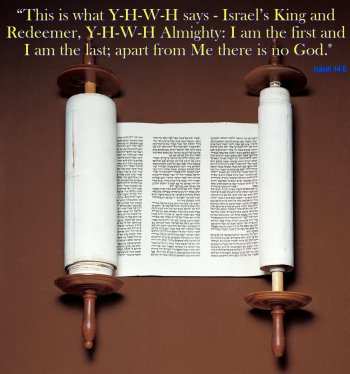
Look here who God is:
Who is God?
LIsten ita a lie that Christian worship the father, you see people with pictures, images of Jesus like the Catholic Church that I dont believe some unlearned people may do so but true believers do not
No true Christians de not worship Jesus But God, the Gospels that contains the words and Actions id Jesus, paint a more complete picture. Jesus consistently directed people to the Father, taught people to pray to the Father, called the Father "the only true God," and lived in complete submission to Him. He never told His disciples to pray to Him or make Him the object of their devotion apart from the Father.
Here are some of the clearest passages (ASV):
Pray ye then after this manner: Our Father who art in heaven, Hallowed be thy name......... (Matthew 6:9)
Jesus did not teach, "Pray to Me." He taught His disciples to pray to the Father!
But thou, when thou prayest, enter into thine inner chamber, and having shut thy door, pray to thy Father who is in secret, and thy Father who seeth in secret shall recompense thee. (Matthew 6:6) Again, Jesus directs all prayer to the Father.
And this is life eternal, that they should know thee the only true God, and him whom thou didst send, even Jesus Christ.(John 17:3)
Here Jesus clearly distinguishes Himself from the Father. The Father is
the only true God, and Jesus is the One whom the Father sent.
A certain ruler asked him, saying, Good Teacher, what shall I do to inherit eternal life? And Jesus said unto him, Why callest thou me good? none is good, save one, even God. (Luke 18:18-19)
Rather than drawing attention to Himself, Jesus points the man back to God.
The Son can do nothing of himself, but what he seeth the Father doing. (John 5:19)
Jesus says His works come from the Father.
I can of myself do nothing. (John 5:30)
Again, Jesus points to His dependence on the Father.
For I have come down from heaven, not to do mine own will, but the will of him that sent me. (John 6:38)
His purpose was to obey the Father's will. and He asks us to do the same.
My teaching is not mine, but his that sent me. (John 7:16) Even His teaching is presented as coming from the Father.
My Father is greater than I. (John 14:28) Jesus openly acknowledges the Father's greater authority.
Why askest thou me concerning that which is good? One there is who is good. (Matthew 19:17)
Again, He directs attention to God.
Not every one that saith unto me, Lord, Lord, shall enter into the kingdom of heaven; but he that doeth the will of my Father who is in heaven. (Matthew 7:21)
The focus is not merely calling Jesus "Lord," but doing the Father's will.
If ye love me, ye will keep my commandments. (John 14:15) Jesus asks for obedience to His teaching, which He repeatedly says comes from the Father.
He that hath my commandments, and keepeth them, he it is that loveth me... (John 14:21)
Love for Jesus is shown by obedience, not by replacing the Father as the object of worship.
Jesus Himself worshiped the Father:
Then saith Jesus unto him, Get thee hence, Satan: for it is written, Thou shalt worship the Lord thy God, and him only shalt thou serve. (Matthew 4:10)
Jesus quotes the Torah, affirming that worship belongs to God alone!
He also prayed to the Father:
Father, if thou be willing, remove this cup from me: nevertheless not my will, but thine, be done. (Luke 22:42)
If Jesus were teaching people to worship Him as the Father, it would make little sense for Him to pray in this way.
After His resurrection He still distinguished between Himself and God:
I ascend unto my Father and your Father, and my God and your God. (John 20:17) Jesus calls the Father
my God.
The disciples followed this pattern after Jesus ascended.
When they asked how to pray, Jesus had already taught them to pray to the Father (Matthew 6:9). In the book of Acts they continued praying to God the Father:
And they lifted up their voice to God with one accord... (Acts 4:24)
Peter also directed glory to God through Jesus:
The God of Abraham, and of Isaac, and of Jacob, the God of our fathers, hath glorified his Servant Jesus. (Acts 3:13)
Notice that Peter calls Jesus God's Servant, and all glory goes to the God of Israel.
This is summed up well in Jesus' own words:
Jesus saith unto him, I am the way, and the truth, and the life: no one cometh unto the Father, but by me. (John 14:6)
Jesus presents Himself as the way to the Father, not as a replacement for the Father. His mission was always to bring people into a right relationship with the God of Israel, whom He called
the only true God (John 17:3).