Weak response.
Zechariah 14:16 And it shall come to pass that everyone who is left of all the nations which came against Jerusalem shall go up from year to year to worship the King, the Lord of hosts, and to keep the Feast of Tabernacles. 17 And it shall be that whichever of the families of the earth do not come up to Jerusalem to worship the King, the Lord of hosts, on them there will be no rain. 18 If the family of Egypt will not come up and enter in, they shall have no rain; they shall receive the plague with which the Lord strikes the nations who do not come up to keep the Feast of Tabernacles. 19 This shall be the punishment of Egypt and the punishment of all the nations that do not come up to keep the Feast of Tabernacles.
If only the righteous are left at this point, then why does this talk about people being punished for not keeping the feast of tabernacles? The righteous would not disobey God like that. And why would anyone even need to keep the feast of tabernacles at that point? That would require animal sacrifices and sin offerings, which were made obsolete by the blood sacrifice of Christ long ago.
Not one place in Zechariah Chapter 14 does it state "Blood Animal Sacrifice"
The feast of tabernacles is presently celebrated by Judaism with items of plant matter surrounding agricultural and the harvest (Myrtle) (Palm Frond) (Willow Branch) (Citron/Lemon)
Wikipedia: Sukkot,
[a] also known as the
Feast of Tabernacles or
Feast of Booths, is a
Torah-commanded
Jewish holiday celebrated for seven days, beginning on the 15th day of the month of
Tishrei. It is one of the
Three Pilgrimage Festivals on which
Israelites were commanded to make a pilgrimage to the
Temple in Jerusalem. Biblically an autumn
harvest festival and a commemoration of
the Exodus from Egypt, Sukkot's modern observance is characterized by festive meals in a
sukkah, a temporary wood-covered hut, and the taking of the
four species.
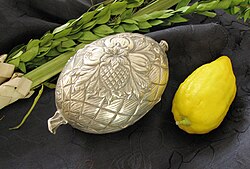
Sukkot's
4 Holy Species from left to right:
Hadass (
myrtle),
Lulav (
palm frond),
Aravah (
willow branch),
Etrog (
citron) carrier, Etrog (citron) outside its carrier
The names used in the Torah are "Festival of Ingathering" (or "Harvest Festival",
Hebrew: חַג הָאָסִיף,
romanized:
ḥag hāʾāsif)
[3] and "Festival of Booths" (
Hebrew: חג הסכות,
romanized:
Ḥag hasSukkōṯ).
[4][3] This corresponds to the double significance of Sukkot. The one mentioned in the
Book of Exodus is agricultural in nature—"Festival of Ingathering at the year's end" (
Exodus 34:22)—and marks the end of the harvest time and thus of the agricultural year in the
Land of Israel. The more elaborate religious significance from the
Book of Leviticus is that of commemorating
the Exodus and the dependence of the
Israelites on the will of God (
Leviticus 23:42–43).
In the Torah's description of the holiday, the idea of welcoming all guests and extending hospitality is intrinsic to the celebration. Actual and symbolic "guests" (Aramaic:
ushpizin) are invited to participate by visiting the sukkah. Specifically, according to the
Zohar, seven "forefathers" of the Jewish people are to be welcomed during the seven days of the festival, in this order: Day 1: Abraham; Day 2: Isaac; Day 3: Jacob; Day 4: Moses; Day 5: Aaron; Day 6: Joseph; Day 7: David.
[5]
The holiday lasts seven days. The first day (and second day in the
diaspora) is a
Shabbat-like
holiday when
work is forbidden. This is followed by intermediate days called
Chol HaMoed, during which certain work is permitted. The festival is closed with another Shabbat-like holiday called
Shemini Atzeret (one day in the Land of Israel, two days in the diaspora, where the second day is called
Simchat Torah).
The Hebrew word
sukkoṯ is the plural of
sukkah ('
booth' or '
tabernacle') which is a walled structure covered with
s'chach (plant material, such as overgrowth or palm leaves). A sukkah is the name of the temporary dwelling in which farmers would live during harvesting, reinforcing agricultural significance of the holiday introduced in the Book of Exodus. As stated in
Leviticus, it is also reminiscent of the type of fragile dwellings in which the Israelites dwelled during their 40 years of travel in the desert after the Exodus from slavery in
Egypt. Throughout the holiday, meals are eaten inside the sukkah and many people sleep there as well.
On each day of the holiday it is a
mitzvah, or commandment, to 'dwell' in the sukkah and to perform a shaking ceremony with a
lulav (a
palm frond, then bound with
myrtle and
willow), and an
etrog (the fruit of a
citron tree) (collectively known as the
four species). The fragile shelter, the 'now-three-item' lulav, the etrog, the revived
Simchat Beit HaShoeivah celebration's focus on water and rainfall and the holiday's harvest festival roots draw attention to people's dependence on the natural environment.




