

Where did Christian Universalism come from? - New or old?
- Thread starter St. SteVen
- Start date
-
Welcome to Christian Forums, a Christian Forum that recognizes that all Christians are a work in progress.
You will need to register to be able to join in fellowship with Christians all over the world.
We hope to see you as a part of our community soon and God Bless!
You are using an out of date browser. It may not display this or other websites correctly.
You should upgrade or use an alternative browser.
You should upgrade or use an alternative browser.
The Learner
Well-Known Member
16. There is next brought before us that declaration uttered by the Saviour in the Gospel: That seeing they may see, and not perceive; and hearing they may hear, and not understand; lest they should happen to be converted, and their sins be forgiven them. On which our opponent will remark: If those who shall hear more distinctly are by all means to be corrected and converted, and converted in such a manner as to be worthy of receiving the remission of sins, and if it be not in their own power to hear the word distinctly, but if it depend on the Instructor to teach more openly and distinctly, while he declares that he does not proclaim to them the word with clearness, lest they should perhaps hear and understand, and be converted, and be saved, it will follow, certainly, that their salvation is not dependent upon themselves. And if this be so, then we have no free-will either as regards salvation or destruction. Now were it not for the words that are added, Lest perhaps they should be converted, and their sins be forgiven them, we might be more inclined to return the answer, that the Saviour was unwilling that those individuals whom He foresaw would not become good, should understand the mysteries of the kingdom of heaven, and that therefore He spoke to them in parables; but as that addition follows, Lest perhaps they should be converted, and their sins be forgiven them, the explanation is rendered more difficult. And, in the first place, we have to notice what defense this passage furnishes against those heretics who are accustomed to hunt out of the Old Testament any expressions which seem, according to their view, to predicate severity and cruelty of God the Creator, as when He is described as being affected with the feeling of vengeance or punishment, or by any of those emotions, however named, from which they deny the existence of goodness in the Creator; for they do not judge of the Gospels with the same mind and feelings, and do not observe whether any such statements are found in them as they condemn and censure in the Old Testament.https://www.newadvent.org/fathers/04123.htmChristian Universalism, the belief that all human beings will eventually be reconciled with God, has its roots in early Christian thought and has reappeared throughout history, but as a formalized movement, it originated in the United States in the 18th century. While earlier figures like Origen of Alexandria in the 3rd century speculated about universal reconciliation, the first organized Universalist church was established in Massachusetts in 1780, marking the beginning of the modern Universalist movement in America, according to Britannica.com.

The Learner
Well-Known Member
And therefore we are rightly rendered liable to condemnation if we transgress those commandments which we are able to keep. And hence He Himself also declares: Every one who hears my words, and does them, I will show to whom he is like: he is like a wise man who built his house upon a rock, etc. So also the declaration: Whoever hears these things, and does them not, is like a foolish man, who built his house upon the sand, etc. Even the words addressed to those who are on His right hand, Come unto Me, all you blessed of My Father, etc.; for I was an hungered, and you gave Me to eat; I was thirsty, and you gave Me drink, manifestly show that it depended upon themselves, that either these should be deserving of praise for doing what was commanded and receiving what was promised, or those deserving of censure who either heard or received the contrary, and to whom it was said, Depart, you cursed, into everlasting fire. Let us observe also, that the Apostle Paul addresses us as having power over our own will, and as possessing in ourselves the causes either of our salvation or of our ruin: Do you despise the riches of His goodness, and of His patience, and of His long-suffering, not knowing that the goodness of God leads you to repentance? But, according to your hardness and impenitent heart, you are treasuring up for yourself wrath on the day of judgment and of the revelation of the just judgment of God, who will render to every one according to his work: to those who by patient continuance in well-doing seek for glory and immortality, eternal life; while to those who are contentious, and believe not the truth, but who believe iniquity, anger, indignation, tribulation, and distress, on every soul of man that works evil, on the Jew first, and (afterwards) on the Greek; but glory, and honour, and peace to every one that does good, to the Jew first, and (afterwards) to the Greek. You will find also innumerable other passages in holy Scripture, which manifestly show that we possess freedom of will. Otherwise there would be a contrariety in commandments being given us, by observing which we may be saved, or by transgressing which we may be condemned, if the power of keeping them were not implanted in us.https://www.newadvent.org/fathers/04123.htmChristian Universalism, the belief that all human beings will eventually be reconciled with God, has its roots in early Christian thought and has reappeared throughout history, but as a formalized movement, it originated in the United States in the 18th century. While earlier figures like Origen of Alexandria in the 3rd century speculated about universal reconciliation, the first organized Universalist church was established in Massachusetts in 1780, marking the beginning of the modern Universalist movement in America, according to Britannica.com.
The Learner
Well-Known Member
man·ySt. SteVen said:
overflow to the many!
Not so. Because "the many" = all.
How many died by the trespass of the one man? (all) The many = all
To how many will the grace of Jesus Christ overflow? (all) The many = all
Romans 5:15
But the gift is not like the trespass. For if the many died by the trespass of the one man,
how much more did God’s grace and the gift that came by the grace of the one man, Jesus Christ, overflow to the many!
[
/ˈmenē/
determiner · adjective
a large number of.
"many people agreed with her"
Similar:
numerous
a great/good deal of
a lot of
a large/great number of
great quantities of
plenty of
countless
innumerable
scores of
crowds of
droves of
an army of
a horde of
a multitude of
a multiplicity of
multitudinous
numberless
multiple
untold
several
various
sundry
diverse
assorted
multifarious
copious
abundant
profuse
an abundance of
a profusion of
frequent
lots of
umpteen
eleventy
loads of
masses of
stacks of
scads of
heaps of
piles of
bags of
tons of
oodles of
dozens of
hundreds of
thousands of
millions of
billions of
zillions of
shedload
a slew of
gazillions of
bazillions of
gobs of
a swag of
myriad
divers
View 1 vulgar slang word
Opposite:
few
pronoun
a large number of people or things.
"it could be the solution to many of our problems"
noun
the majority of people.
"their vision is that trade is in the interest of the many, not the few"
Synonyms of all
1
a
: the whole amount, quantity, or extent of
needed all the courage they had
sat up all night
b
: as much as possible
spoke in all seriousness
2
: every member or individual component of
all men will go
all five children were present
3
: the whole number or sum of
all the angles of a triangle are equal to two right angles
4
: EVERY
all manner of hardship
5
: any whatever
beyond all doubt
6
: nothing but : ONLY
all work and no play
:
a
: completely taken up with, given to, or absorbed by
became all attention
b
: having or seeming to have (some physical feature) in conspicuous excess or prominence
all legs
c
: paying full attention with
all ears
7
dialect : used up : entirely consumed —used especially of food and drink
8
: being more than one person or thing
I don't know who all is coming.
all
2 of 4
adverb
1
a
: WHOLLY, QUITE
sat all alone
—often used as an intensive
all out of proportion
all over the yard
it wasn't all that funny
b
: selected as the best (as at a sport) within an area or organization —used in combination
all-league halfback
2
obsolete : ONLY, EXCLUSIVELY
3
archaic : JUST
4
: so much
all the better for it
5
: for each side : APIECE
the score is two all
all
3 of 4
pronoun
singular or plural in construction
1
a
: the whole number, quantity, or amount : TOTALITY
all that I have
all of us
all of the books
b
—used in such phrases as for all I know, for all I care, and for all the good it does to indicate a lack of knowledge, interest, or effectiveness
2
: EVERYBODY, EVERYTHING
gave equal attention to all
that is all
The Learner
Well-Known Member
Please define your understanding of UniversalismAs usual, you are demonstrating your ignorance about Universalism.
[
The Learner
Well-Known Member
17 “My brothers, I know that what you did to Jesus was done because you did not understand what you were doing. And your leaders did not understand any more than you did. 18 But God said these things would happen. Through the prophets he said that his Messiah would suffer and die. I have told you how God made this happen. 19 So you must change your hearts and lives. Come back to God, and he will forgive your sins. 20 Then the Lord will give you times of spiritual rest. He will send you Jesus, the one he chose to be the Messiah.Being born again before the Age of Restoration (Judgement) is only for the Elect.
God chooses who will be in that number.
Acts 3:21 NIV
Heaven must receive him until the time comes for God to restore everything,
as he promised long ago through his holy prophets.
[
21 “But Jesus must stay in heaven until the time when all things will be made right again. God told about this time when he spoke long ago through his holy prophets. 22 Moses said, ‘The Lord your God will give you a prophet. That prophet will come from among your own people. He will be like me. You must obey everything he tells you. 23 And anyone who refuses to obey that prophet will die, separated from God’s people.’
24 “Samuel, and all the other prophets who spoke for God after Samuel, said that this time would come. 25 And what those prophets talked about is for you, their descendants. You have received the agreement that God made with your fathers. God said to your father Abraham, ‘Every nation on earth will be blessed through your descendants.’[c] 26 God has sent his special servant Jesus. He sent him to you first. He sent him to bless you by causing each of you to turn away from your evil ways.”
The Learner
Well-Known Member
pancakes?What does it say about God if his plan for humankind was to destroy the vast majority?
Seems he could have come up with a better plan.
A whole universe subject to a half-baked plan? (flop) ???
[


@The Learner, it's too much for me to understand.
Of course! Here's a condensed version of the passage that keeps the heart of its argument intact:
Summary:
The Gospel verse “that seeing they may see, and not perceive…” raises a difficult theological question: if Jesus intentionally spoke in parables to prevent understanding, conversion, and forgiveness, does this imply that salvation is not within a person’s control, challenging the concept of free will?
This dilemma is deepened by the phrase “lest they should be converted…” which seems to imply that understanding leads directly to salvation—making it unclear why this understanding would be withheld.
Despite this tension, the passage defends the view that humans do have free will and moral responsibility. Scriptural examples—from Jesus' teachings to Paul’s letters—affirm that individuals are accountable for their choices. Righteous action leads to reward, while disobedience brings consequences. Thus, commandments and judgments make sense only if people have the capacity to choose freely.
The passage also counters claims that the Old Testament paints God as cruel or vengeful, pointing out that similar expressions appear in the New Testament, suggesting a consistent divine approach rooted in justice—not harshness.
Of course! Here's a condensed version of the passage that keeps the heart of its argument intact:
Summary:
The Gospel verse “that seeing they may see, and not perceive…” raises a difficult theological question: if Jesus intentionally spoke in parables to prevent understanding, conversion, and forgiveness, does this imply that salvation is not within a person’s control, challenging the concept of free will?
This dilemma is deepened by the phrase “lest they should be converted…” which seems to imply that understanding leads directly to salvation—making it unclear why this understanding would be withheld.
Despite this tension, the passage defends the view that humans do have free will and moral responsibility. Scriptural examples—from Jesus' teachings to Paul’s letters—affirm that individuals are accountable for their choices. Righteous action leads to reward, while disobedience brings consequences. Thus, commandments and judgments make sense only if people have the capacity to choose freely.
The passage also counters claims that the Old Testament paints God as cruel or vengeful, pointing out that similar expressions appear in the New Testament, suggesting a consistent divine approach rooted in justice—not harshness.
The Learner
Well-Known Member
not keeping up concerning Matthew 25:46 if you limit everlasting for punishment then you will have to limit it for life too.
In Matthew 25:46, the Greek phrase "εἰς κόλασιν αἰώνιον" (eis kolasin aionion) translates to "into everlasting punishment." "Kolasin" is a noun in the accusative singular feminine form, meaning "punishment," while "aionion" is the adjective, also in the accusative singular feminine form, meaning "everlasting" or "eternal." The phrase "eis zoen aionion" ("into eternal life") is also present in the verse, making a direct comparison between the nature of punishment and life.
In Matthew 25:46, the Greek phrase "εἰς κόλασιν αἰώνιον" (eis kolasin aionion) translates to "into everlasting punishment." "Kolasin" is a noun in the accusative singular feminine form, meaning "punishment," while "aionion" is the adjective, also in the accusative singular feminine form, meaning "everlasting" or "eternal." The phrase "eis zoen aionion" ("into eternal life") is also present in the verse, making a direct comparison between the nature of punishment and life.
| Matthew 25:46 ► |
| Text Analysis Go to Parallel Greek
|
The Learner
Well-Known Member
The Greek of Matthew 25:46
Matthew 25:46 does indeed say 'everlasting punishment.' Hard words.
www.daily-bible-study-tips.com
The Learner
Well-Known Member
- Now, in some cases in the NT, aionios is coupled with chronos time (e.g., Romans 16:25, 2 Timothy 1:9, Titus 1:2), where it means something like “the long lasting ages.” This only occurs when the word is linked with chronos, which it is not in vs. 46.
- In classical usage, the adjective can refer to things “lasting an age,” but also to “eternal” things. Matthew 25 reflects the primary meaning of the word, and the vast majority of usages in the NT: “eternal.” There is no reason in Matthew to translate it anything but “eternal.”
- Another problem is a question of logic, not of grammar. In Matthew 25:46, Jesus refers to both “eternal life” and “eternal punishment.” Dr. Parsenios says, “Are we to believe that the word eternal means everlasting when it refers to life, but that something totally different is in mind when it refers to punishment - with no notice in the text that the meaning of the word has changed? I can't take that possibility seriously.”
- Just to be absolutely certain, Dr. Parsenios looked at the Theological Dictionary of the New Testament (ed. G. Kittel), and the Greek-English Lexicon of the New Testament Early Christian Literature (ed. Bauer, et al), and they confirmed what he has said here. He added that the definitive commentary on Matthew by W. D. Davies and Dale Allison doesn’t even raise the question as a possibility, so certain is the translation “eternal.”
- The Greek of Matthew 25:46
The Learner
Well-Known Member

"the many" = allman·y
/ˈmenē/
determiner · adjective
a large number of.
"many people agreed with her"
Similar:
numerous
a great/good deal of
a lot of
a large/great number of
great quantities of
plenty of
countless
innumerable
scores of
crowds of
droves of
an army of
a horde of
a multitude of
a multiplicity of
multitudinous
numberless
multiple
untold
several
various
sundry
diverse
assorted
multifarious
copious
abundant
profuse
an abundance of
a profusion of
frequent
lots of
umpteen
eleventy
loads of
masses of
stacks of
scads of
heaps of
piles of
bags of
tons of
oodles of
dozens of
hundreds of
thousands of
millions of
billions of
zillions of
shedload
a slew of
gazillions of
bazillions of
gobs of
a swag of
myriad
divers
View 1 vulgar slang word
Opposite:
few
pronoun
a large number of people or things.
"it could be the solution to many of our problems"
noun
the majority of people.
"their vision is that trade is in the interest of the many, not the few"
Synonyms of all
1
a
: the whole amount, quantity, or extent of
needed all the courage they had
sat up all night
b
: as much as possible
spoke in all seriousness
2
: every member or individual component of
all men will go
all five children were present
3
: the whole number or sum of
all the angles of a triangle are equal to two right angles
4
: EVERY
all manner of hardship
5
: any whatever
beyond all doubt
6
: nothing but : ONLY
all work and no play
:
a
: completely taken up with, given to, or absorbed by
became all attention
b
: having or seeming to have (some physical feature) in conspicuous excess or prominence
all legs
c
: paying full attention with
all ears
7
dialect : used up : entirely consumed —used especially of food and drink
8
: being more than one person or thing
I don't know who all is coming.
all
2 of 4
adverb
1
a
: WHOLLY, QUITE
sat all alone
—often used as an intensive
all out of proportion
all over the yard
it wasn't all that funny
b
: selected as the best (as at a sport) within an area or organization —used in combination
all-league halfback
2
obsolete : ONLY, EXCLUSIVELY
3
archaic : JUST
4
: so much
all the better for it
5
: for each side : APIECE
the score is two all
all
3 of 4
pronoun
singular or plural in construction
1
a
: the whole number, quantity, or amount : TOTALITY
all that I have
all of us
all of the books
b
—used in such phrases as for all I know, for all I care, and for all the good it does to indicate a lack of knowledge, interest, or effectiveness
2
: EVERYBODY, EVERYTHING
gave equal attention to all
that is all
Romans 5:18-19 NIV
Consequently, just as one trespass resulted in condemnation for all people,
so also one righteous act resulted in justification and life for all people.
19 For just as through the disobedience of the one man the many were made sinners,
so also through the obedience of the one man the many will be made righteous.
[
The good news is that one age follows another.not keeping up concerning Matthew 25:46 if you limit everlasting for punishment then you will have to limit it for life too.
Only one age is needed for the restoration of all things.
[
The Learner
Well-Known Member
The text is in format of parallel something."the many" = all
Romans 5:18-19 NIV
Consequently, just as one trespass resulted in condemnation for all people,
so also one righteous act resulted in justification and life for all people.
19 For just as through the disobedience of the one man the many were made sinners,
so also through the obedience of the one man the many will be made righteous.
[
| Romans 5:18 ► |
| Text Analysis Go to Parallel Greek
|
The Learner
Well-Known Member
| Romans 5:19 ► |
| Text Analysis Go to Parallel Greek
|
example: All my Students went to Ball game, but many were there.
The difference in Romans text is some did not commit their lives to Jesus.
The Learner
Well-Known Member
Romans 5
Easy-to-Read Version
Right With God
5 We have been made right with God because of our faith. So we have peace with God through our Lord Jesus Christ. 2 Through our faith, Christ has brought us into that blessing of God’s grace that we now enjoy. And we are very happy because of the hope we have of sharing God’s glory. 3 And we are also happy with the troubles we have. Why are we happy with troubles? Because we know that these troubles make us more patient. 4 And this patience is proof that we are strong. And this proof gives us hope. 5 And this hope will never disappoint us. We know this because God has poured out his love to fill our hearts through the Holy Spirit he gave us.
6 Christ died for us when we were unable to help ourselves. We were living against God, but at just the right time Christ died for us. 7 Very few people will die to save the life of someone else, even if it is for a good person. Someone might be willing to die for an especially good person. 8 But Christ died for us while we were still sinners, and by this God showed how much he loves us.
9 We have been made right with God by the blood sacrifice of Christ. So through Christ we will surely be saved from God’s anger. 10 I mean that while we were God’s enemies, he made friends with us through his Son’s death. And the fact that we are now God’s friends makes it even more certain that he will save us through his Son’s life. 11 And not only will we be saved, but we also rejoice right now in what God has done for us through our Lord Jesus Christ. It is because of Jesus that we are now God’s friends.
Adam and Christ
12 Sin came into the world because of what one man did. And with sin came death. So this is why all people must die—because all people have sinned. 13 Sin was in the world before the Law of Moses. But God does not consider people guilty of sin if there is no law. 14 But from the time of Adam to the time of Moses, everyone had to die. Adam died because he sinned by not obeying God’s command. But even those who did not sin that same way had to die.
That one man, Adam, can be compared to Christ, the one who was coming in the future. 15 But God’s free gift is not like Adam’s sin. Many people died because of the sin of that one man. But the grace that people received from God was much greater. Many received God’s gift of life by the grace of this other man, Jesus Christ. 16 After Adam sinned once, he was judged guilty. But the gift of God is different. His free gift came after many sins, and it makes people right with him. 17 One man sinned, and so death ruled all people because of that one man. But now some people accept God’s full grace and his great gift of being made right. Surely they will have true life and rule through the one man, Jesus Christ.
18 So that one sin of Adam brought the punishment of death to all people. But in the same way, Christ did something so good that it makes all people right with God. And that brings them true life. 19 One man disobeyed God and many became sinners. But in the same way, one man obeyed God and many will be made right. 20 The law was brought in so that more people would sin the way Adam did. But where sin increased, there was even more of God’s grace. 21 Sin once used death to rule us. But God gave us more of his grace so that grace could rule by making us right with him. And this brings us eternal life through Jesus Christ our Lord.
Easy-to-Read Version
Right With God
5 We have been made right with God because of our faith. So we have peace with God through our Lord Jesus Christ. 2 Through our faith, Christ has brought us into that blessing of God’s grace that we now enjoy. And we are very happy because of the hope we have of sharing God’s glory. 3 And we are also happy with the troubles we have. Why are we happy with troubles? Because we know that these troubles make us more patient. 4 And this patience is proof that we are strong. And this proof gives us hope. 5 And this hope will never disappoint us. We know this because God has poured out his love to fill our hearts through the Holy Spirit he gave us.
6 Christ died for us when we were unable to help ourselves. We were living against God, but at just the right time Christ died for us. 7 Very few people will die to save the life of someone else, even if it is for a good person. Someone might be willing to die for an especially good person. 8 But Christ died for us while we were still sinners, and by this God showed how much he loves us.
9 We have been made right with God by the blood sacrifice of Christ. So through Christ we will surely be saved from God’s anger. 10 I mean that while we were God’s enemies, he made friends with us through his Son’s death. And the fact that we are now God’s friends makes it even more certain that he will save us through his Son’s life. 11 And not only will we be saved, but we also rejoice right now in what God has done for us through our Lord Jesus Christ. It is because of Jesus that we are now God’s friends.
Adam and Christ
12 Sin came into the world because of what one man did. And with sin came death. So this is why all people must die—because all people have sinned. 13 Sin was in the world before the Law of Moses. But God does not consider people guilty of sin if there is no law. 14 But from the time of Adam to the time of Moses, everyone had to die. Adam died because he sinned by not obeying God’s command. But even those who did not sin that same way had to die.
That one man, Adam, can be compared to Christ, the one who was coming in the future. 15 But God’s free gift is not like Adam’s sin. Many people died because of the sin of that one man. But the grace that people received from God was much greater. Many received God’s gift of life by the grace of this other man, Jesus Christ. 16 After Adam sinned once, he was judged guilty. But the gift of God is different. His free gift came after many sins, and it makes people right with him. 17 One man sinned, and so death ruled all people because of that one man. But now some people accept God’s full grace and his great gift of being made right. Surely they will have true life and rule through the one man, Jesus Christ.
18 So that one sin of Adam brought the punishment of death to all people. But in the same way, Christ did something so good that it makes all people right with God. And that brings them true life. 19 One man disobeyed God and many became sinners. But in the same way, one man obeyed God and many will be made right. 20 The law was brought in so that more people would sin the way Adam did. But where sin increased, there was even more of God’s grace. 21 Sin once used death to rule us. But God gave us more of his grace so that grace could rule by making us right with him. And this brings us eternal life through Jesus Christ our Lord.
The Learner
Well-Known Member
AMP
For just as through one man’s disobedience [his failure to hear, his carelessness] the many were made sinners, so through the obedience of the one Man the many will be made righteous and acceptable to God and brought into right standing with Him.
AMPC
For just as by one man’s disobedience (failing to hear, heedlessness, and carelessness) the many were constituted sinners, so by one Man’s obedience the many will be constituted righteous (made acceptable to God, brought into right standing with Him).
BRG
For as by one man’s disobedience many were made sinners, so by the obedience of one shall many be made righteous.
CSB
For just as through one man’s disobedience the many were made sinners, so also through the one man’s obedience the many will be made righteous.
PHILLIPS
We see, then, that as one act of sin exposed the whole race of men to God’s judgment and condemnation, so one act of perfect righteousness presents all men freely acquitted in the sight of God. One man’s disobedience placed all men under the threat of condemnation, but one man’s obedience has the power to present all men righteous before God.
This to me seems a pretty simply one, but it’s going to be troublesome if people only quote verse 18 and you’re not aware of verse 19 which clarifies verse 18.
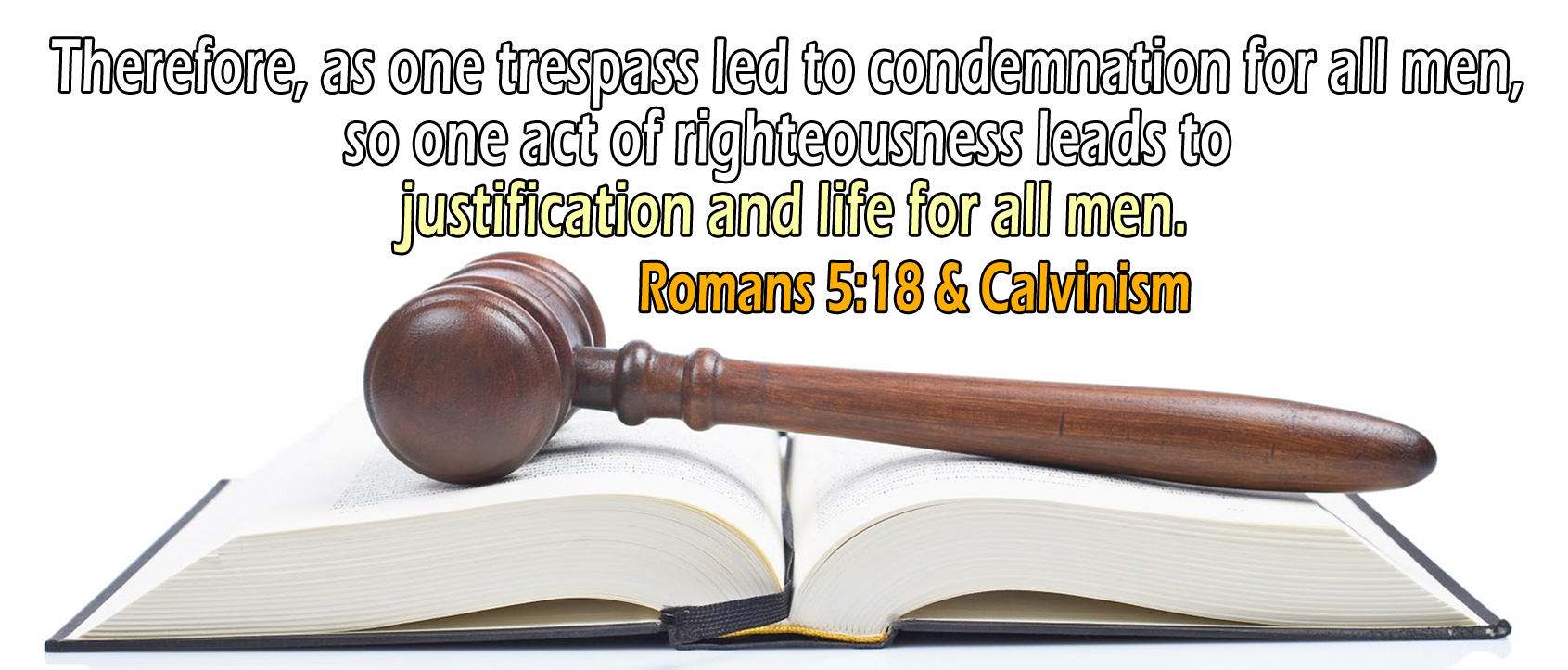
 www.thecalvinist.net
For just as through one man’s disobedience [his failure to hear, his carelessness] the many were made sinners, so through the obedience of the one Man the many will be made righteous and acceptable to God and brought into right standing with Him.
AMPC
For just as by one man’s disobedience (failing to hear, heedlessness, and carelessness) the many were constituted sinners, so by one Man’s obedience the many will be constituted righteous (made acceptable to God, brought into right standing with Him).
BRG
For as by one man’s disobedience many were made sinners, so by the obedience of one shall many be made righteous.
CSB
For just as through one man’s disobedience the many were made sinners, so also through the one man’s obedience the many will be made righteous.
PHILLIPS
We see, then, that as one act of sin exposed the whole race of men to God’s judgment and condemnation, so one act of perfect righteousness presents all men freely acquitted in the sight of God. One man’s disobedience placed all men under the threat of condemnation, but one man’s obedience has the power to present all men righteous before God.
This to me seems a pretty simply one, but it’s going to be troublesome if people only quote verse 18 and you’re not aware of verse 19 which clarifies verse 18.
| Adam | Christ |
|---|---|
| One trespass led to condemnation for “all” | One act of righteousness leads to justification and life for “all” |
| One disobedience leads to “the many” made sinners | One obedience leads to the justification of “the many” |
Romans 5:18-19, 'justification and life for all men'
Therefore, as one trespass led to condemnation for all men, so one act of righteousness leads to justification and life for all men. 19 For as by the one man's disobedience the many were made sinners, so by the one man's obedience the many will be made righteous. Romans 5:18-19 (ESV)
The Learner
Well-Known Member
I see verse 18 as the punishment plentily of Adam. 19 as the promise of Jesus's on the cross.
a. Much more then, having now been justified by His blood, we shall be saved from wrath: If we are justified by the work of Jesus, we can be assured that we are also saved from wrath through Him. The wrath of God that was revealed from heaven against all ungodliness and unrighteousness of men (Romans 1:18) was placed on Jesus as a substitute in the place of the believer.
a. One man’s offense… one Man’s righteous act: From this passage, Adam and Jesus are sometimes known as the two men. Between them they represent all humanity, and everyone is identified in either Adam or Jesus. We are born identified with Adam; we may be born again into identification with Jesus.
i. The idea of Adam and Jesus as two representatives of the human race is sometimes called Federal Theology, or Adam and Jesus are sometimes referred to as Federal Heads. This is because under the federal system of government, representatives are chosen and the representative speaks for the people who chose him. Adam speaks for those he represents, and Jesus speaks for His people.
ii. Again, someone may object: “But I never chose to have Adam represent me.” Of course you did! You identified yourself with Adam with the first sin you ever committed. It is absolutely true that we were born into our identification with Adam, but we also choose it with our individual acts of sin.
b. Resulting in condemnation… resulting in justification: The outcome of this election – choosing Adam or Jesus – means everything. If we choose Adam, we receive judgment and condemnation. If we choose Jesus, we receive the free gift of God’s grace and justification.
c. The free gift came to all men: Does this mean that all men are justified by the free gift? Without making a personal choice, every person received the curse of Adam’s offense. Is it therefore true that every person, apart from their personal choice, will receive the benefits of Jesus’ obedience? Not at all. First, Paul makes it clear that the free gift is not like the offense – they are not identical in their result or in their application. Second, over three verses Paul calls the work of Jesus a free gift, and he never uses those words to apply to the work of Adam. It is simply the nature of a gift that it must be received by faith. Finally, Paul clearly teaches throughout the New Testament that all are not saved.
i. In what sense then did the free gift come to all men? It came in the sense that the gift is presented, but not necessarily received.
ii. The idea that all men are saved by the work of Jesus whether they know it or not is known as universalism. “If the doctrine of universalism is being taught here, Paul would be contradicting himself, for he has already pictured men as perishing because of sin.” (Harrison)
a. Much more then, having now been justified by His blood, we shall be saved from wrath: If we are justified by the work of Jesus, we can be assured that we are also saved from wrath through Him. The wrath of God that was revealed from heaven against all ungodliness and unrighteousness of men (Romans 1:18) was placed on Jesus as a substitute in the place of the believer.
4. (18) Summary: the two men.
Therefore, as through one man’s offense judgment came to all men, resulting in condemnation, even so through one Man’s righteous act the free gift came to all men, resulting in justification of life.a. One man’s offense… one Man’s righteous act: From this passage, Adam and Jesus are sometimes known as the two men. Between them they represent all humanity, and everyone is identified in either Adam or Jesus. We are born identified with Adam; we may be born again into identification with Jesus.
i. The idea of Adam and Jesus as two representatives of the human race is sometimes called Federal Theology, or Adam and Jesus are sometimes referred to as Federal Heads. This is because under the federal system of government, representatives are chosen and the representative speaks for the people who chose him. Adam speaks for those he represents, and Jesus speaks for His people.
ii. Again, someone may object: “But I never chose to have Adam represent me.” Of course you did! You identified yourself with Adam with the first sin you ever committed. It is absolutely true that we were born into our identification with Adam, but we also choose it with our individual acts of sin.
b. Resulting in condemnation… resulting in justification: The outcome of this election – choosing Adam or Jesus – means everything. If we choose Adam, we receive judgment and condemnation. If we choose Jesus, we receive the free gift of God’s grace and justification.
c. The free gift came to all men: Does this mean that all men are justified by the free gift? Without making a personal choice, every person received the curse of Adam’s offense. Is it therefore true that every person, apart from their personal choice, will receive the benefits of Jesus’ obedience? Not at all. First, Paul makes it clear that the free gift is not like the offense – they are not identical in their result or in their application. Second, over three verses Paul calls the work of Jesus a free gift, and he never uses those words to apply to the work of Adam. It is simply the nature of a gift that it must be received by faith. Finally, Paul clearly teaches throughout the New Testament that all are not saved.
i. In what sense then did the free gift come to all men? It came in the sense that the gift is presented, but not necessarily received.
ii. The idea that all men are saved by the work of Jesus whether they know it or not is known as universalism. “If the doctrine of universalism is being taught here, Paul would be contradicting himself, for he has already pictured men as perishing because of sin.” (Harrison)
The Learner
Well-Known Member
5. (19) Summary of the contrasts.
For as by one man’s disobedience many were made sinners, so also by one Man’s obedience many will be made righteous.a. By one man’s disobedience: Adam’s disobedience makes mankind sinners. Jesus’ obedience makes many righteous. Each representative communicates the effect of their work to their “followers.”
b. Many were made sinners: Paul emphasizes the point again. At the root, we were made sinners by the work of Adam. Of course, we chose Adam when we personally sinned. But the principle remains that since another man made us sinners, we can be made righteous by the work of another man.
i. This is the only way for the work of Jesus to benefit us in any way. If every man must stand for himself, without the representation of either Adam or Jesus, then we will all perish. None would be saved, because each of us sins and falls short of the glory of God. Only a sinless person acting on our behalf can save us, and it is fair for Him to act on our behalf because another man put us in this mess by acting on our behalf.
ii. If I robbed a bank and was found guilty of the crime, a friend could not say to the judge, “Your honor, I love my friend and I want to serve his prison time. I will stand in his place and receive the punishment he deserves.” The judge would reply, “Nonsense. We will not punish you for his crime. That wouldn’t be fair. He did the crime, so he has to pay the penalty.” It would only be fair for another person to pay the penalty if I were guilty because of another person’s work.
iii. The person who says, “I don’t want to be represented by Adam or Jesus; I want to represent myself” doesn’t understand two things. First, they don’t understand that it really isn’t up to us. We didn’t make the rules, God did. Secondly, they don’t understand that our personal righteousness before God is as filthy rags (Isaiah 64:6). To God, our personal righteousness is an offensive counterfeit; so standing for yourself guarantees damnation.

Enduring Word Bible Commentary Romans Chapter 5
David Guzik commentary on Romans 5, where Paul points out the benefits of being justifies through faith and contrasts the work between Adam and Jesus.
 enduringword.com
Similar threads

- Replies
- 135
- Views
- 8K


- Replies
- 229
- Views
- 16K

- Replies
- 558
- Views
- 36K

- Replies
- 252
- Views
- 23K
